TL;DR
Predictive maintenance works best when asset signals, work orders, and vendor dispatch live in one operating flow. Commercial building teams should start with critical HVAC, refrigeration, MEP, and life-safety assets, then connect sensor alerts to clear actions, owners, and cost tracking.
Predictive maintenance software for commercial buildings turns asset data into early warnings before a chiller, rooftop unit, pump, or electrical system disrupts operations. In 2026, the strongest programs combine condition monitoring, CMMS workflows, mobile task tracking, and vendor coordination rather than treating prediction as a standalone dashboard. CMMS: A computerized maintenance management system is software that maintains a database of maintenance operations, based on the standard definition from Wikipedia. Platforms such as Leansite help facilities teams connect maintenance requests, asset history, and execution so predictive alerts turn into completed work, not ignored notifications.
Table of Contents
What is predictive maintenance software for commercial buildings?
Predictive maintenance software for commercial buildings is a system that monitors asset condition, detects abnormal patterns, and triggers maintenance before failure. It uses data from sensors, building management systems, inspections, meters, and work orders to prioritize repairs by risk, cost, and operational impact.
Predictive maintenance: a maintenance approach that uses condition data and historical patterns to estimate when equipment needs service.
Condition monitoring: ongoing measurement of signals such as vibration, temperature, runtime, pressure, current draw, and fault codes.
Configuration management: a process for maintaining consistency between an asset's expected design, function, and performance, aligned with the general definition from Wikipedia.
Key insight: Prediction is only useful when it changes the next action, such as dispatching a technician, ordering a part, or escalating a vendor visit.
Most commercial buildings already produce useful signals. The issue is that data often sits in separate tools: BMS dashboards, spreadsheets, contractor reports, meter portals, and email threads. Predictive platforms pull those signals closer to the work order process.
Which assets and signals matter most?
The best predictive maintenance targets assets where failure is expensive, disruptive, or hard to diagnose manually. HVAC, refrigeration, elevators, pumps, electrical panels, generators, lighting controls, and plumbing systems usually create the clearest business case because downtime affects tenants, shoppers, staff, or compliance.
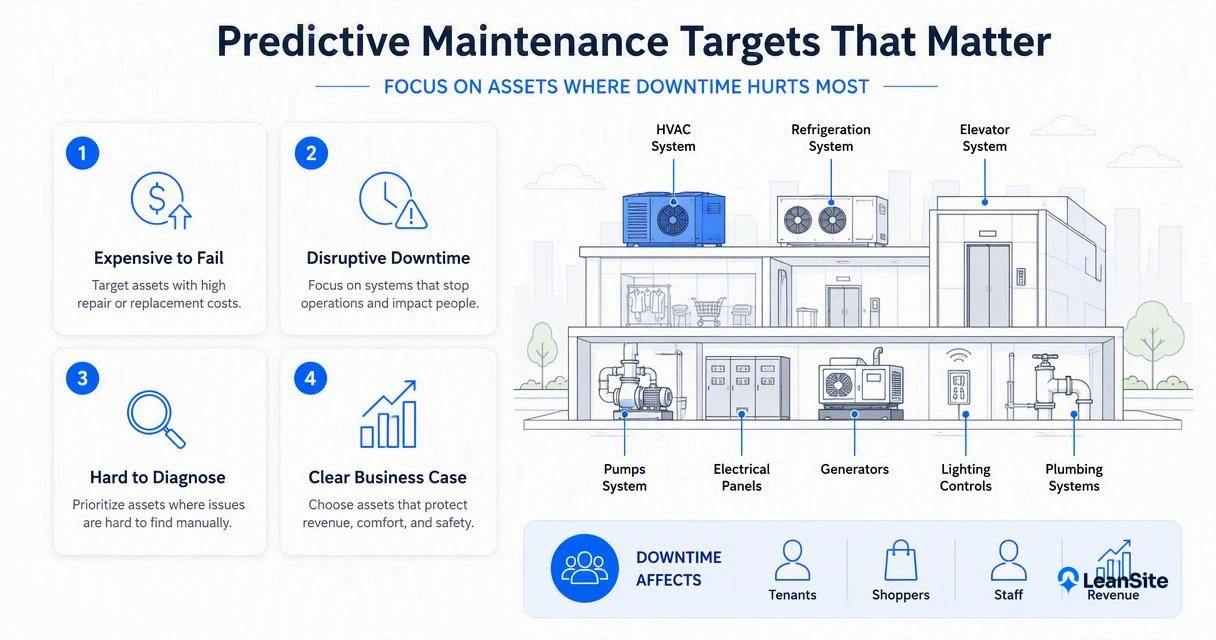
Commercial maintenance leaders do not need to instrument every asset on day one. A practical rollout starts with the top 10 to 20 percent of assets that drive comfort complaints, emergency callouts, energy waste, or revenue disruption.
High-value building signals to track
| Asset type | Useful signals | Predictive action |
|---|---|---|
| Rooftop HVAC units | Runtime, fault codes, temperature drift, compressor cycling | Schedule technician before comfort complaints spike |
| Chillers and boilers | Pressure, flow, temperature, vibration, energy draw | Inspect components before performance drops |
| Refrigeration | Case temperature, door events, defrost cycles, alarms | Prevent product loss and after-hours emergencies |
| Pumps and motors | Vibration, amperage, bearing temperature, runtime | Replace wear parts before motor failure |
| Electrical systems | Load, heat, breaker events, generator test results | Reduce outage risk and document inspections |
A common mistake is treating more data as better data. Facilities teams need signals tied to decisions. For example, compressor short-cycling should create a different response than a single thermostat complaint.
Useful predictive inputs include:
- Live sensor readings from IoT devices
- Fault codes from building automation systems
- Preventive maintenance records
- Technician notes and photos
- Vendor invoices and repeat repair history
- Asset age, warranty, and replacement cost
- Tenant or store-level service requests
For a deeper operational view, Leansite's guide to maximizing facility uptime with predictive maintenance explains how early action reduces reactive work without adding noise to the maintenance queue.
How does predictive maintenance software improve daily operations?
Predictive maintenance improves daily operations by shifting teams from calendar-only inspections to risk-based work. Instead of checking every asset on the same schedule, managers can focus labor, parts, and vendor spend on equipment showing real signs of deterioration.
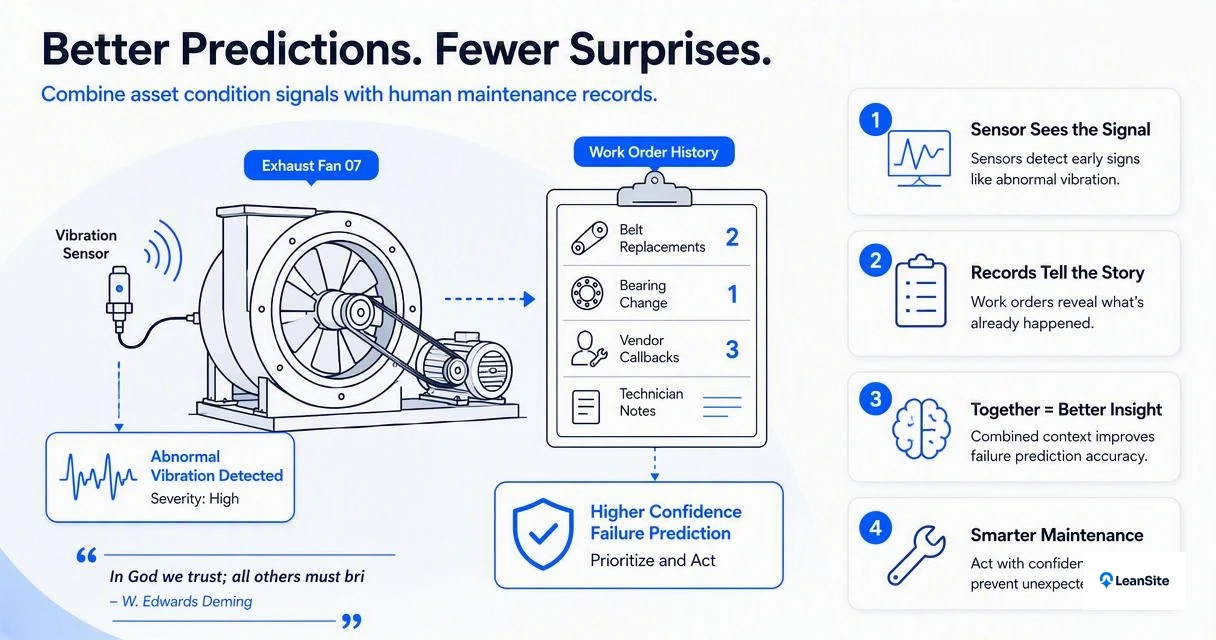
The practical benefit is not magic AI. The win is cleaner prioritization. A weak predictive program creates alerts; a strong one creates assigned, timed, trackable work.
Workflow from alert to completed work
- Collect asset data from sensors, BMS, inspections, or technician input.
- Compare current performance with normal ranges and past failures.
- Score risk based on severity, asset importance, and business impact.
- Create a work order with the asset, location, symptom, and recommended task.
- Route the job to an internal technician or approved vendor.
- Capture photos, notes, labor, parts, and final resolution.
- Feed completed work history back into future maintenance planning.
This is where maintenance software must connect operations, not just analytics. Multi-site organizations need one way to view open work, vendor response, asset history, and cost patterns across buildings. The Leansite platform is built for that operating layer, especially where corporate teams need visibility without slowing down local teams.
Predictive maintenance also improves contractor accountability. When fault history, response time, repeat visits, and invoice data are visible, vendors no longer "mark their own homework." That phrase matters because commercial buildings often depend on third parties for HVAC, refrigeration, electrical, and plumbing work.
Teams managing many properties can extend this model with dispatch rules and automation. The related guide on vendor dispatch and predictive maintenance automation for multi-site teams covers how alerts move from data to vendor action.
How should teams choose software in 2026?
Commercial building teams should choose software that connects predictive signals to maintenance execution, vendor workflows, asset history, and cost reporting. A platform that predicts failure but cannot trigger clean work orders, approvals, and closeout documentation will leave value trapped in dashboards.
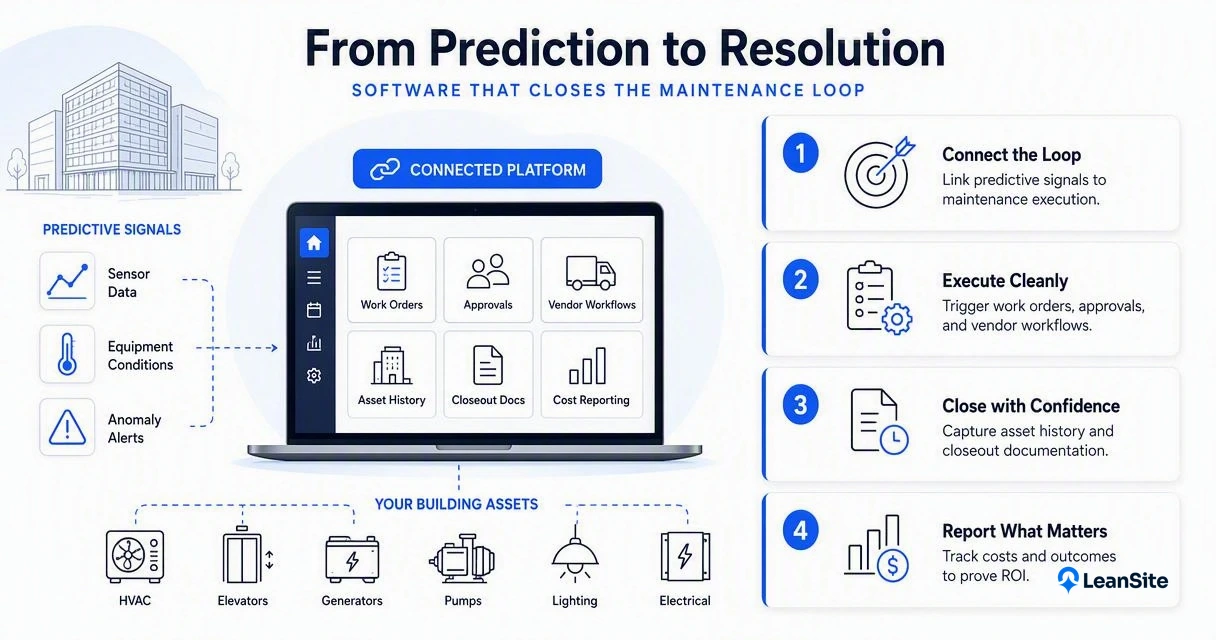
Buying decisions should start with the operating model. A single office tower, a retail portfolio, and a distributed healthcare network have very different needs.
Evaluation checklist for buyers
- Asset coverage: supports HVAC, refrigeration, MEP, life-safety, and location-specific equipment.
- Data connections: accepts BMS, IoT, meter, inspection, and manual condition data.
- Work order automation: turns warnings into assigned tasks with priority and due dates.
- Vendor coordination: tracks dispatch, SLAs, quotes, approvals, invoices, and repeat work.
- Mobile usability: works for technicians in mechanical rooms, rooftops, basements, and low-signal areas.
- Portfolio visibility: compares cost, downtime, and asset performance across sites.
- AI governance: explains recommendations enough for managers to trust the next action.
Artificial intelligence can help classify issues and spot patterns, but oversight still matters. The 2023 International Journal of Information Management paper on generative AI by Dwivedi, Kshetri, Hughes, and coauthors discusses both opportunities and risks in AI-assisted work, including the need for responsible use and human judgment (Elsevier PDF).
For multi-site selection, the guide to best multi-site maintenance software in 2026 is a useful follow-up. Teams comparing broader AI tools can also review AI facility management software.
What should commercial buildings expect next?
Predictive maintenance will become more workflow-centered through 2027, with less attention on raw alerts and more attention on automated triage, vendor orchestration, and capital planning. The most useful systems will explain which assets need action, why the risk matters, and what work should happen next.
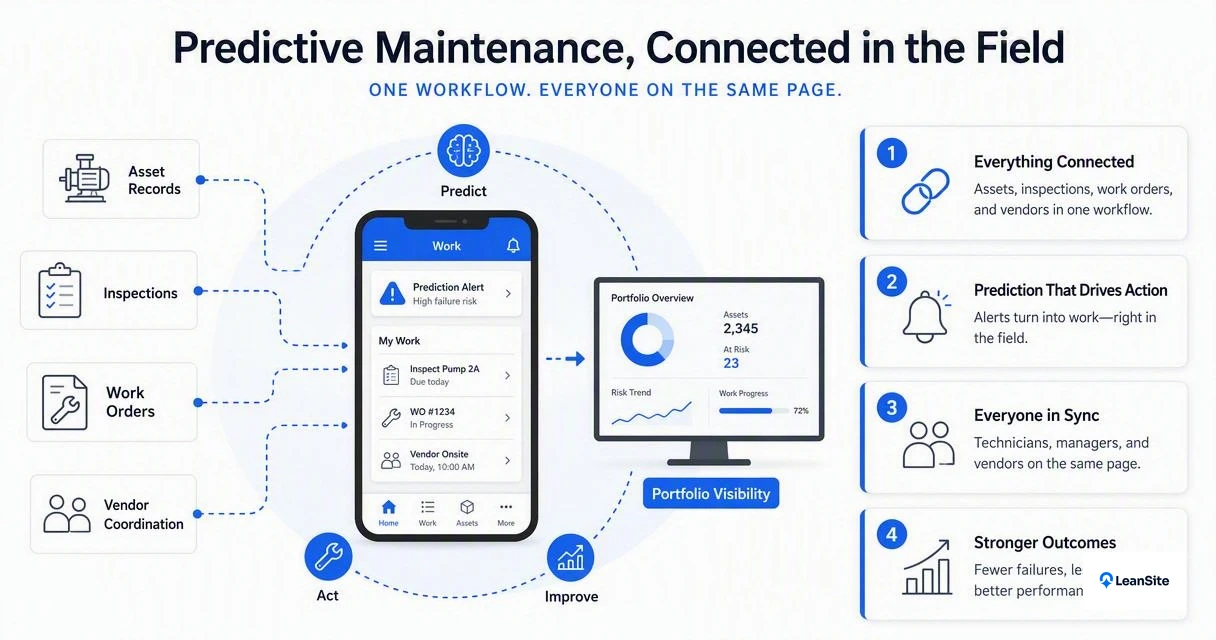
Near-term changes to watch
| Trend | What changes | Why it matters |
|---|---|---|
| AI-assisted triage | Alerts grouped by risk, asset, and location | Fewer false alarms and faster decisions |
| Vendor-aware automation | Dispatch based on trade, SLA, region, and warranty | Less manual coordination for multi-site teams |
| Cost-linked asset scoring | Repair history tied to replacement planning | Better capital budget conversations |
| Offline mobile work | Field updates captured in low-signal areas | More complete records from mechanical spaces |
| Portfolio benchmarking | Sites compared by downtime and spend | Easier visibility for owners and executives |
Predictive maintenance will also blur into preventive maintenance. Calendar-based tasks still have value for compliance, warranties, and routine checks. The better approach is a blended model where critical inspections stay scheduled while condition data adjusts timing and priority.
Teams building from a basic PM process can start with a preventive maintenance ticket flow, then add sensors and condition rules where failure risk justifies the effort. For portfolios with limited connectivity, the guide to offline maintenance software helps plan field adoption.
Leansite fits this next phase by keeping prediction connected to requests, work orders, vendors, and cost visibility. For teams ready to see how that looks in practice, getleansite.com is the direct next stop.
FAQ
What data is required to start predictive maintenance?
A building can start with asset lists, work order history, failure records, inspection notes, and basic meter or fault data. Sensors improve accuracy, but clean maintenance history often reveals repeat failures, chronic assets, and high-cost locations before a full IoT rollout.
Is predictive maintenance only for large commercial buildings?
Predictive maintenance is most common in large or multi-site portfolios, but smaller properties can use the same logic on high-risk assets. Rooftop HVAC units, pumps, refrigeration, generators, and electrical equipment often justify early monitoring because failures create urgent service calls and tenant disruption.
How is predictive maintenance different from preventive maintenance?
Preventive maintenance follows a planned schedule, such as quarterly filter changes or annual inspections. Predictive maintenance adjusts work based on actual condition signals, such as abnormal temperature drift, vibration, runtime, or repeat faults. Strong programs use both methods together.
What is the biggest implementation risk?
The biggest risk is creating alerts that no one owns. Predictive software needs clear thresholds, work order routing, vendor rules, and closeout standards. Without those steps, warnings pile up in dashboards while maintenance teams continue reacting to calls.
Can predictive maintenance reduce vendor costs?
Predictive maintenance can reduce waste when it catches issues earlier, limits emergency dispatch, and shows repeat repair patterns. It also improves vendor discussions because managers can compare response times, recurring failures, asset history, and invoice trends with better evidence.
Conclusion
Predictive maintenance software for commercial buildings works when prediction, execution, and accountability stay connected. The next step is simple: identify the highest-risk assets, confirm what data already exists, and map how an alert becomes a completed work order. Teams that want one place for maintenance requests, vendor dispatch, asset history, and portfolio visibility can evaluate Leansite and visit getleansite.com to plan a practical rollout.