TL;DR
Facility teams should verify COIs, coverage limits, licenses, expiration dates, and approved vendor status before assigning maintenance work. A practical system links vendor compliance to work orders, so dispatch stays fast without sending uninsured or unapproved contractors on site.
One expired certificate of insurance can turn a routine HVAC repair into a liability headache. Contractor insurance tracking software gives facility teams a clear way to confirm vendor compliance before work starts, not after an incident. For teams already managing work orders, assets, and vendors, Leansite helps connect contractor readiness to day-to-day maintenance execution without adding another messy spreadsheet.
Table of Contents
What is contractor insurance tracking software?
Contractor insurance tracking software is a system for collecting, reviewing, storing, and monitoring contractor insurance documents, licenses, coverage limits, expiration dates, and approved vendor status. It helps facility and operations teams confirm that outside vendors meet company requirements before dispatching work orders.
Contractor management: Contractor management is the management of outsourced work performed for a company, including health and safety information, insurance records, training, and job readiness.
In facilities operations, the main document is usually the certificate of insurance, or COI. A COI summarizes insurance policies such as general liability, workers' compensation, auto liability, and umbrella coverage. The document alone is not enough; teams also need to know whether the policy is current, whether limits match site requirements, and whether the vendor is approved for the job type.
"An ounce of prevention is worth a pound of cure.", Benjamin Franklin, Founders Online
That idea fits vendor compliance well. Prevention means checking eligibility before a contractor enters a building, climbs a roof, services electrical equipment, or drives between sites.
Why facilities teams verify COIs before dispatch
Facilities teams verify COIs before dispatch because contractor risk shows up at the property, not in the back office. A vendor may be skilled, responsive, and familiar with a site, but still create exposure if coverage has lapsed or license status is unclear.
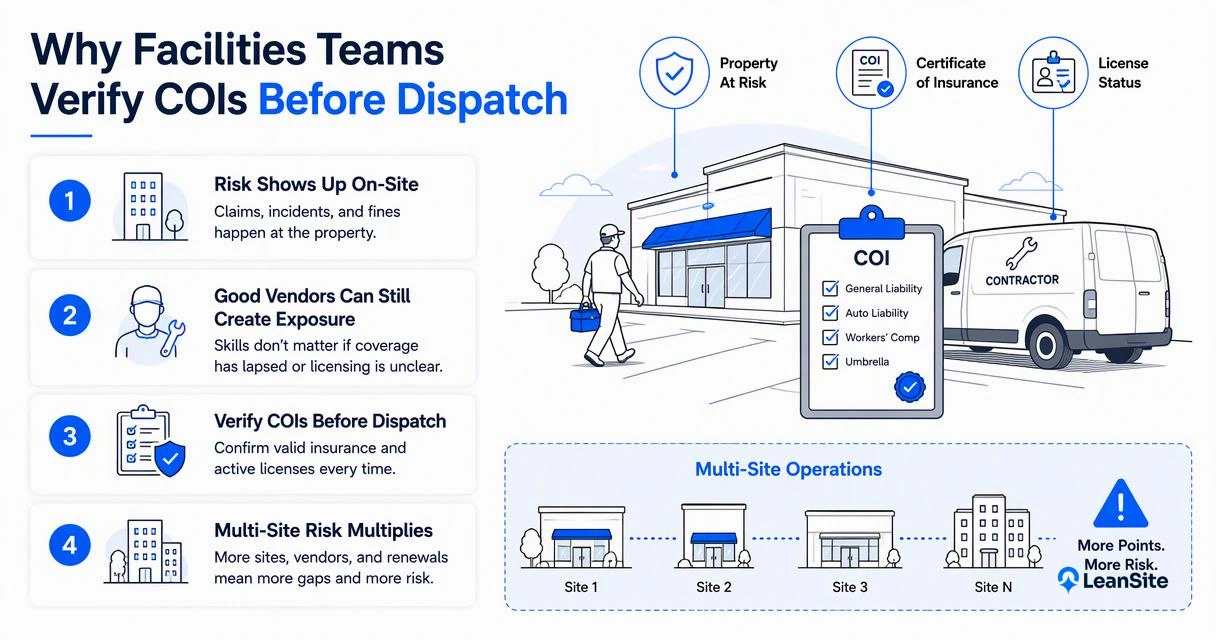
For multi-site operators, the problem grows quickly. A regional facilities team may manage plumbers, electricians, landscapers, janitorial vendors, fire-life-safety contractors, and emergency trades across dozens of locations. A complete multi-location facilities management system helps keep work, vendors, and operating visibility connected.
Pre-dispatch checks that reduce risk
-
COI status: Confirms that required insurance documents are on file.
-
Expiration date: Flags expired or soon-to-expire policies before work is assigned.
-
Coverage limits: Compares policy limits against company or site requirements.
-
License records: Tracks trade licenses, business licenses, and location-specific credentials.
-
Approved vendor status: Shows whether a contractor can receive work for a site, region, or trade.
-
Scope match: Confirms that the vendor is approved for the requested service type.
The goal is not to slow dispatch. The goal is to prevent a dispatcher from making a risky assignment under time pressure. Fast work order routing still matters, especially for leaks, power loss, access issues, refrigeration failures, and safety concerns.
A practical rule works well: if a vendor is not compliant, the system should either block assignment or require a documented override. That keeps accountability visible without burying the facilities team in email threads.
What should a strong tracking system monitor in 2026?
A strong contractor compliance system in 2026 should track more than uploaded documents. It should connect insurance, licenses, vendor approval, work order assignment, renewal reminders, audit history, and site-level requirements in one workflow.
Research on construction technology keeps pointing toward smarter automation. A 2021 Journal of Building Engineering review, Artificial intelligence in the construction industry, covers AI's present status, opportunities, and future challenges in construction. For facilities teams, that trend matters because document review, routing, and exception handling are moving from manual inbox work to assisted workflows.
Compliance fields worth tracking
|
Field |
Why it matters |
Dispatch impact |
|---|---|---|
|
Company profile |
Identifies the legal vendor entity, contacts, service area, and trade |
Prevents assigning work to the wrong business unit |
|
COI document |
Stores proof of active insurance coverage |
Lets teams verify coverage before site access |
|
Policy expiration |
Shows when coverage becomes outdated |
Triggers renewal tasks before a work order is assigned |
|
Coverage limits |
Confirms required dollar limits for liability and workers' comp |
Blocks vendors that fall below site standards |
|
License type |
Verifies trade authorization for electrical, plumbing, HVAC, or specialty work |
Matches qualified vendors to regulated work |
|
Approved status |
Shows whether procurement, legal, or operations has cleared the vendor |
Keeps unapproved contractors out of active dispatch |
|
Audit trail |
Records changes, approvals, overrides, and document history |
Supports internal review after incidents or disputes |
Spreadsheets can store some of this data, but they rarely enforce action at the moment of dispatch. A work order platform with strong visibility can make compliance part of daily maintenance, which is why work order visibility features matter for vendor-heavy teams.
"In God we trust. All others must bring data.", W. Edwards Deming, The W. Edwards Deming Institute
Good compliance data also improves cost control. A 2022 Energy Strategy Reviews systematic review on energy efficiency in sustainable buildings focuses on building performance challenges and pathways for future research. Better vendor records support that broader operations goal because qualified contractors affect maintenance quality, equipment reliability, and building outcomes.
How Leansite keeps vendor dispatch fast
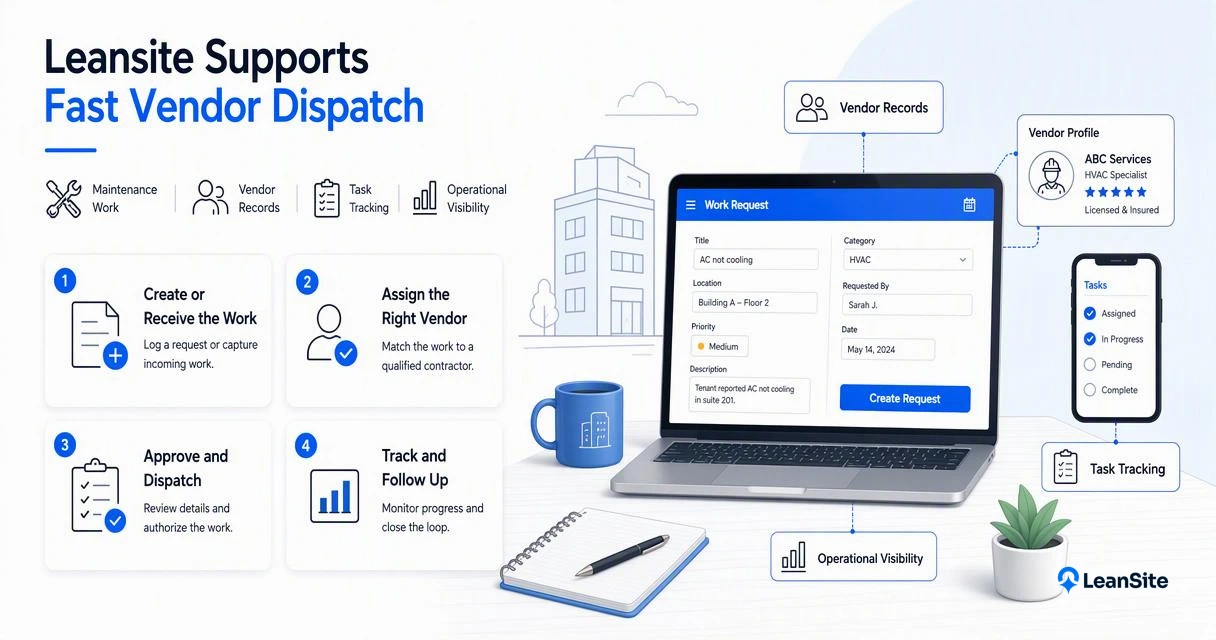
Leansite supports fast vendor dispatch by keeping maintenance work, vendor records, task tracking, and operational visibility close together. The Leansite platform is built for facilities teams that need fewer handoffs between work requests, contractor assignment, approvals, and follow-up.
A simple workflow for safer assignment
-
Create or receive the work order: A repair request enters the system with location, asset, issue type, priority, and due date.
-
Match the vendor to the trade: The dispatcher filters contractors by service category, location, and availability.
-
Check compliance before assignment: COI status, expiration dates, license records, and approved status are reviewed before dispatch.
-
Assign the job with context: The contractor receives the task details, site notes, photos, access instructions, and response expectations.
-
Track completion and proof: The team captures job updates, invoices, notes, and any follow-up work tied to the asset or site.
-
Trigger renewal work: Expiring insurance or licenses create admin tasks before they affect future dispatch.
AI also has a growing role in this workflow. Facility teams evaluating automation can compare broader patterns in AI facility management software and see how assistants such as Vera in Leansite support faster maintenance coordination.
Tool fit by operating model
|
Operating model |
Best-fit approach |
Why it works |
|---|---|---|
|
Single property |
Basic vendor file plus renewal reminders |
Lower volume, fewer compliance variations |
|
Regional portfolio |
Work order system with vendor compliance fields |
Dispatch speed and consistency matter across sites |
|
National facilities team |
Central vendor database with site rules and audit trails |
Different states, trades, and approvals need structure |
|
Contractor-heavy operations |
Integrated dispatch, documentation, and payment handoff |
Less duplicate admin work for facilities and vendors |
Teams comparing platforms should also consider total maintenance context, not just COI storage. The best choice often depends on whether contractor compliance needs to live inside a larger multi-site maintenance software strategy.
Field mileage context for dispatched vendors
Mileage and dispatch records are separate from insurance compliance, but both affect contractor oversight. Vendor teams that travel between sites need clean job history, accurate timestamps, and clear payment support. With Leansite, operations teams can keep the work record tied to the site and asset instead of scattering details across texts and inboxes. More product details are available at getleansite.com.
FAQ
Is a COI the same as insurance coverage?
A COI is proof that an insurance policy exists, but it is not the policy itself. Facilities teams should still check coverage types, limits, expiration dates, named insured details, and any additional insured requirements. The safest process treats the COI as a summary that must match company rules before dispatch.
How often should contractor insurance records be reviewed?
Contractor insurance records should be reviewed before the first job, before renewal dates, and before assigning high-risk work. Many teams also run monthly exception reports for expiring COIs, expired licenses, missing documents, and vendors marked inactive. The right review cycle depends on contractor volume and site risk.
Can spreadsheets handle contractor compliance tracking?
Spreadsheets can work for a small vendor list, but they become weak when multiple sites, trades, expiration dates, and approval rules are involved. They store data, but they do not reliably stop a noncompliant dispatch. Software is stronger when compliance needs to connect directly to work orders.
What should happen when a vendor is not approved?
A non-approved vendor should not receive routine work until missing insurance, licensing, or internal approval items are resolved. Emergency exceptions should require a manager's documented approval, a reason, and follow-up task. That process keeps urgent repairs moving while preserving accountability.
Conclusion
Contractor insurance tracking software works best when it sits close to the work order process. COIs, expiration dates, coverage limits, licenses, and approved vendor status should be checked before assignment, not after a job is complete. Facility leaders evaluating a better vendor workflow can map current dispatch steps, list required compliance fields, and test whether the system blocks risky assignments without slowing urgent maintenance. For a facilities-first approach, visit getleansite.com and review how Leansite connects vendor coordination with day-to-day maintenance execution.