TL;DR
Facility teams reduce surprise failures when each asset has a complete record: location, warranty, preventive tasks, repair history, condition score, and replacement plan. The best approach is to standardize asset data first, then connect work orders, vendors, budgets, and capital planning in one operating system.
A clean asset record can turn facilities work from guesswork into a budgetable operating rhythm. Asset lifecycle management for facilities is the practice of tracking building assets from inventory and installation through maintenance, repair, renewal, and disposal. Asset management: a systematic approach to governing and realizing value from tangible or intangible assets, aligned with the definition used by Wikipedia. Leansite fits this work when facility teams need asset records, task tracking, vendor coordination, and visibility across multiple locations.
Table of Contents
What is asset lifecycle management for facilities?
Asset lifecycle management for facilities is the operating method for managing HVAC units, kitchen equipment, roofs, elevators, electrical panels, plumbing systems, fixtures, and other physical assets from purchase to retirement. It connects asset data, maintenance work, repair history, condition, cost, and replacement timing so teams can protect uptime and plan capital spending.
The idea is simple: every asset should have a living record. That record should explain what the asset is, where it sits, who services it, what work has been completed, what warranty applies, and when replacement becomes smarter than another repair.
"In God we trust. All others must bring data.", W. Edwards Deming, The W. Edwards Deming Institute
For facility leaders, that quote lands hard. Repair decisions based on memory usually favor the loudest problem, not the most expensive risk. Lifecycle records bring quieter risks into view before they become urgent work orders.
Core facility asset terms
-
Asset inventory: The master list of equipment, systems, locations, serial numbers, models, and ownership details.
-
Warranty capture: The storage of warranty dates, coverage terms, vendor contacts, and claim documents.
-
Preventive task: A recurring maintenance action scheduled by time, meter, season, usage, or condition.
-
Repair history: The work order trail showing failures, parts, labor, vendors, invoices, and downtime.
-
Condition score: A simple rating that combines age, performance, risk, and repair frequency.
-
Replacement plan: A budget forecast for renewal, disposal, or major overhaul.
What lifecycle stages should every facility asset record include?
Every facility asset record should include six stages: inventory, warranty, preventive maintenance, repair history, condition scoring, and replacement planning. These stages give facilities directors a complete view of cost, risk, reliability, and future capital needs without forcing every decision through spreadsheets and email threads.
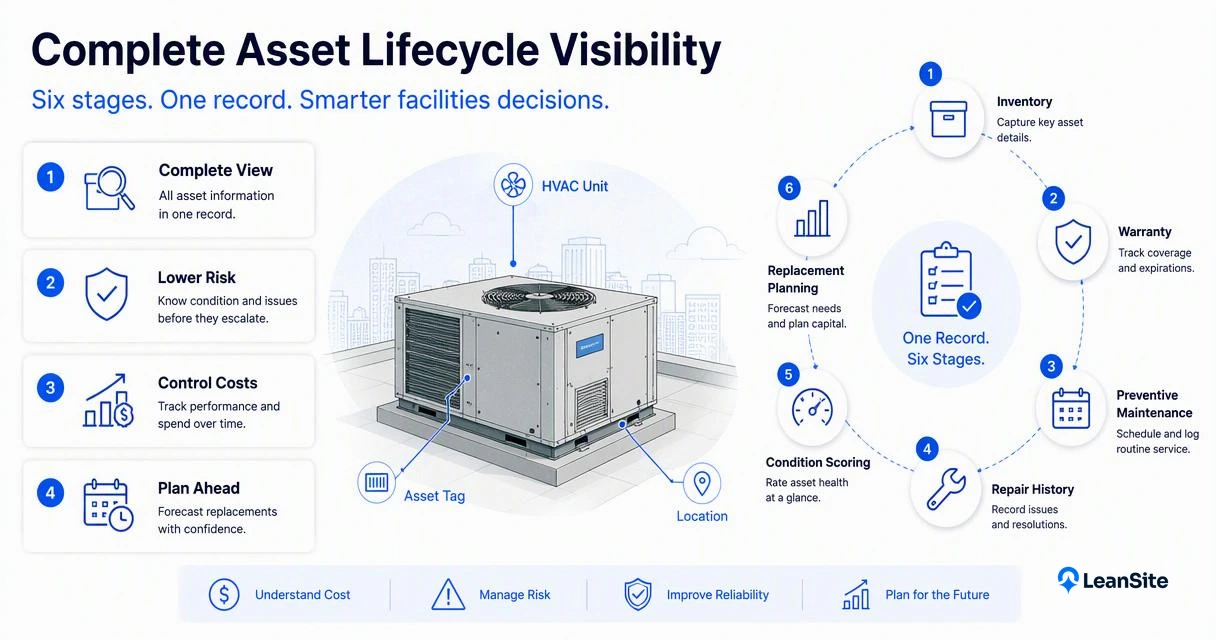
IBM describes asset lifecycle management as spanning the full life of an asset, from planning through operation and retirement, in its overview of asset lifecycle management. Facilities teams can adapt that broad model into a more practical building-operations framework.
Facility asset lifecycle table
|
Stage |
What to capture |
Why it matters |
|---|---|---|
|
Inventory |
Asset ID, location, model, serial number, install date |
Creates the source of truth |
|
Warranty |
Coverage dates, vendor, exclusions, documents |
Prevents missed claims and duplicate spending |
|
Preventive tasks |
PM schedule, checklist, assigned team, frequency |
Reduces avoidable breakdowns |
|
Repair history |
Work orders, parts, labor, vendor notes, photos |
Shows true cost and repeat issues |
|
Condition score |
Age, uptime, safety risk, repair trend, criticality |
Ranks assets by replacement priority |
|
Replacement plan |
Estimated replacement year, budget, lead time |
Improves capital forecasting |
Asset records need ownership, not just data
A lifecycle process fails when nobody owns record quality. One team may add equipment, another may schedule preventive work, and a vendor may close repairs. Clear ownership keeps asset histories from becoming half-filled folders.
A practical ownership model assigns responsibility by data type:
-
Facilities admin owns asset creation and naming standards.
-
Technicians own PM completion notes and photos.
-
Vendors own service notes, parts used, and invoice detail.
-
Managers own condition scores and replacement decisions.
-
Finance owns capitalization rules and budget categories.
Multi-site operators also need consistent naming across locations. A guide to multi-location facilities management software can help teams standardize records before portfolio reporting gets messy.
How should facility teams implement lifecycle management?
Facility teams should implement lifecycle management by building a clean inventory, attaching warranties, linking preventive maintenance, recording every repair, scoring asset condition, and reviewing replacement plans during budget cycles. The process works best when work orders and vendor activity feed the asset record automatically.
A phased rollout beats a giant data cleanup. High-risk and high-cost equipment should come first, such as HVAC, refrigeration, elevators, generators, fire-life-safety systems, roofs, and production-critical fixtures.
A 6-step rollout plan
-
Start with critical assets: Rank assets by safety impact, downtime risk, repair cost, and customer impact.
-
Create naming rules: Use one format for asset ID, location, type, and parent-child relationships.
-
Attach documents: Add manuals, warranties, permits, inspection reports, photos, and vendor contracts.
-
Connect work orders: Require every PM and repair ticket to reference the correct asset.
-
Score condition quarterly: Use age, repair count, downtime, parts availability, and operational risk.
-
Review replacements annually: Tie replacement candidates to budget cycles, lease obligations, and lead times.
Work orders are the heartbeat of lifecycle data. Teams comparing systems can review the best facilities ticket management system for 2026 for practical ticketing considerations.
Lifecycle video example
The video shows a common asset-management pattern: central records, status tracking, and lifecycle visibility. Facilities teams should adapt that pattern for physical building assets, especially when maintenance history and vendor work need to stay tied to each piece of equipment.
Common implementation mistakes
-
Creating assets without required fields.
-
Letting technicians close work orders without asset links.
-
Storing warranty files in email instead of asset records.
-
Treating condition scoring as a one-time exercise.
-
Budgeting replacements only after repeated failures.
Connectivity also matters. Poor mobile access and weak field communication can break the data chain, especially across distributed properties. The operational impact is covered in the hidden cost of poor connectivity in facilities management.
How Leansite handles lifecycle visibility
Leansite supports lifecycle visibility by connecting facility requests, work tracking, vendor coordination, and asset context in one place. That matters because lifecycle records only stay useful when daily maintenance activity updates them, rather than sitting apart from operations.
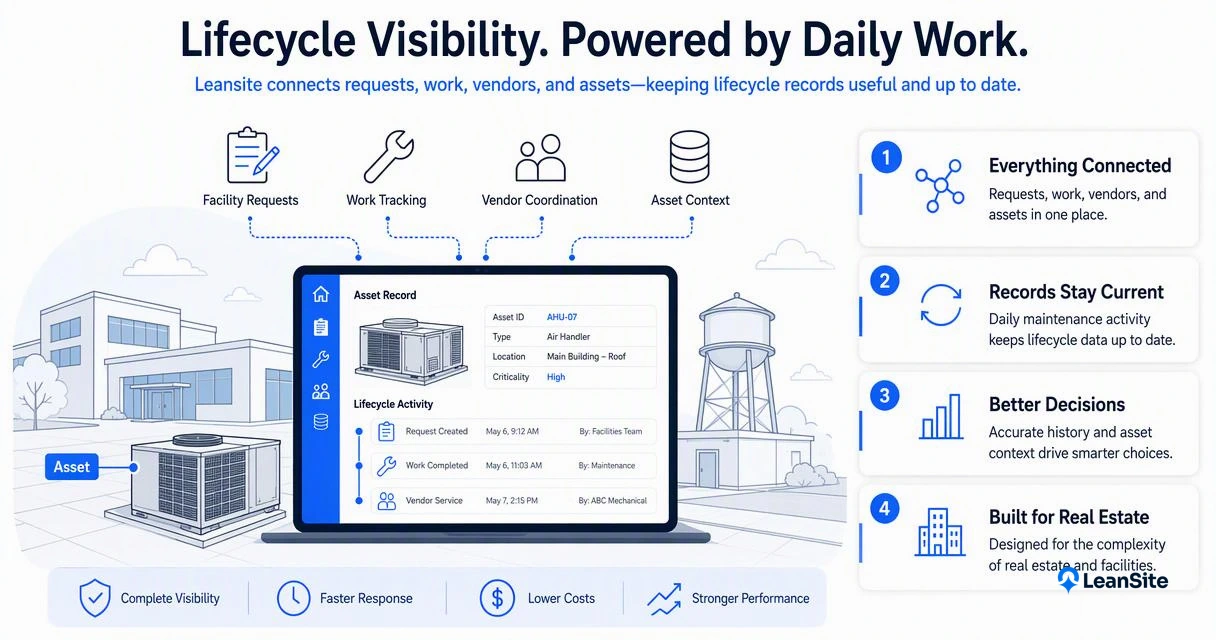
The Leansite platform is especially relevant for teams managing many sites, where assets, vendors, and recurring work can vary by region. AI-assisted facility workflows are also becoming more useful as teams sort work, summarize issues, and spot repeat failures faster; related context appears in this guide to AI facility management software.
Where lifecycle software creates value
|
Need |
Manual approach |
Connected platform approach |
|---|---|---|
|
Warranty claims |
Search email and folders |
Warranty tied to asset record |
|
Repeat repairs |
Memory and vendor calls |
Repair history by asset |
|
PM compliance |
Calendar reminders |
Recurring tasks and completion logs |
|
Vendor work |
Phone calls and invoices |
Dispatch, notes, photos, status |
|
Capital planning |
Annual spreadsheet rebuild |
Condition and cost trends over time |
For restaurant groups, retailers, clinics, campuses, and other distributed operators, lifecycle data also helps compare locations fairly. The maintenance needs of chain environments are discussed in facilities management for restaurant chains.
What to expect in 2027
By 2027, lifecycle management will rely more on AI summaries, photo-based evidence, vendor performance data, and predictive maintenance signals. The useful shift will not be flashy automation. The real gain will come from faster decisions: repair, replace, defer, or inspect.
Vera, the AI assistant built into Leansite, points toward that future by helping teams work with facility data faster. More detail is available in the article on Vera in Leansite AI's facility management software.
FAQ about facility asset lifecycle management
Facility asset lifecycle management questions usually center on scope, data quality, replacement timing, and software fit. Clear answers help teams move from scattered maintenance records to a repeatable asset program.
Which assets should be tracked first?
Critical, expensive, and failure-prone assets should be tracked first. HVAC units, refrigeration, elevators, generators, fire-life-safety systems, roofs, electrical gear, and specialized operating equipment usually deserve priority because downtime, compliance risk, or replacement cost can be high.
How often should condition scores be updated?
Condition scores should be reviewed at least quarterly for critical assets and annually for lower-risk assets. Scores should also change after major repairs, failed inspections, repeated service calls, visible deterioration, or performance complaints from operations teams.
What data is needed for replacement planning?
Replacement planning needs install date, expected useful life, repair history, annual maintenance cost, downtime impact, parts availability, safety risk, and estimated replacement lead time. Finance teams also need budget category, capitalization status, and timing assumptions.
Can small facilities use lifecycle management?
Small facilities can use the same framework with fewer fields and simpler workflows. A small site may start with asset ID, location, warranty, PM schedule, repair history, and replacement year. The value comes from consistency, not complexity.
Conclusion
Asset lifecycle management for facilities gives maintenance teams a practical way to reduce surprise failures, defend budgets, and make replacement decisions with evidence. The next step is simple: choose the 20 most critical assets, build complete records, connect all work orders, and review condition scores every quarter. For teams ready to move from spreadsheets to connected facilities operations, visit getleansite.com and evaluate how Leansite can support the asset lifecycle from request to replacement.