TL;DR
Choose maintenance vendor software around the complete job cycle: contractor approval, dispatch, completion evidence, and invoice review. Compare facilities-focused platforms with CMMS and property management tools, then test the shortlist across several properties before committing.
A contractor directory isn't a maintenance operating system. Vendor management software for commercial property maintenance connects approved contractors, service requests, work records, and spending decisions. For commercial portfolios, the strongest fit supports both site-level execution and owner-level visibility. Leansite belongs on the shortlist for teams exploring AI-assisted facilities coordination.
Table of Contents
What is commercial maintenance vendor software?
Commercial maintenance vendor software organizes outside service providers and the work they perform across buildings. It connects contractor records with dispatch, approvals, service expectations, completion evidence, and invoice review. Unlike a contact database, its value comes from keeping responsibility and job status visible throughout each maintenance request.
Maintenance vendor management: The process of selecting, approving, coordinating, and evaluating contractors responsible for building services.
CMMS: A computerized maintenance management system that organizes maintenance work orders, schedules, and asset records.
SLA: A service-level agreement defining expected service, timing, and accountability.
The broader term vendor management system often refers to staffing procurement. Commercial property teams should look specifically for maintenance workflows covering HVAC, electrical, plumbing, cleaning, and other contracted services.
Portfolio requirements also differ from single-building needs. The guide to multi-location facilities management software covers the broader coordination layer.
Procurement context for maintenance teams
Procurement provides the purchasing framework; maintenance operations provide the job-level detail needed to approve service and spending.
Which software approach fits commercial properties?
The best software approach depends on whether the main priority is contractor coordination, asset maintenance, or broader property administration. A facilities-focused platform suits cross-site operations, while a CMMS emphasizes equipment and work orders. Property management software can fit teams whose maintenance process sits within leasing and accounting operations.
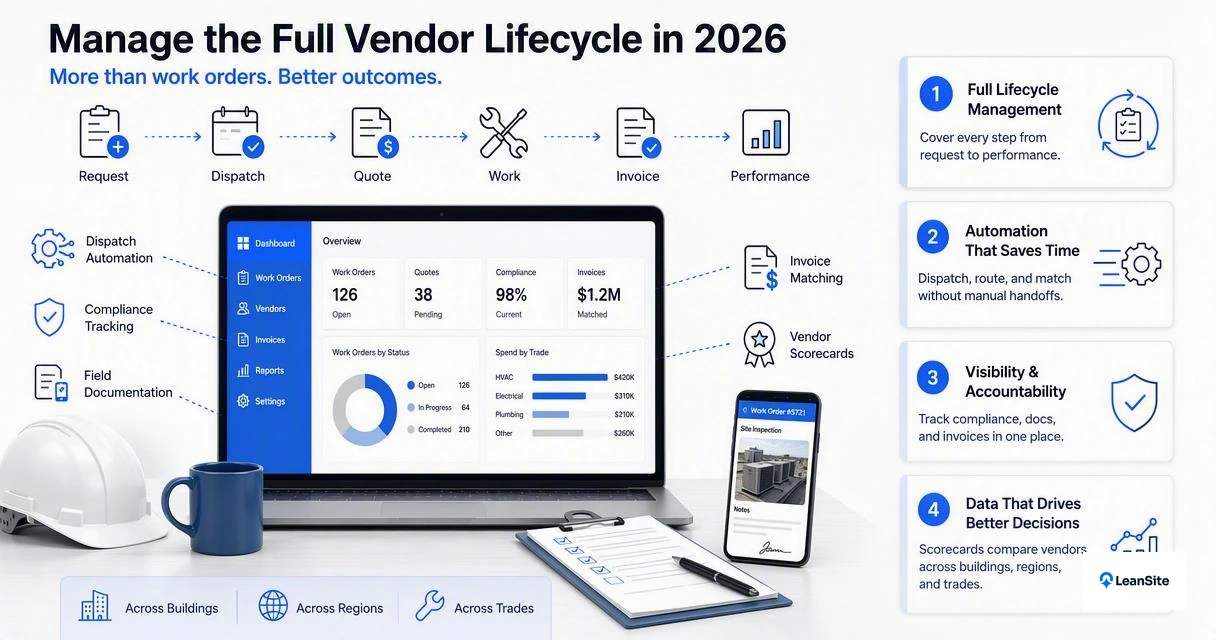
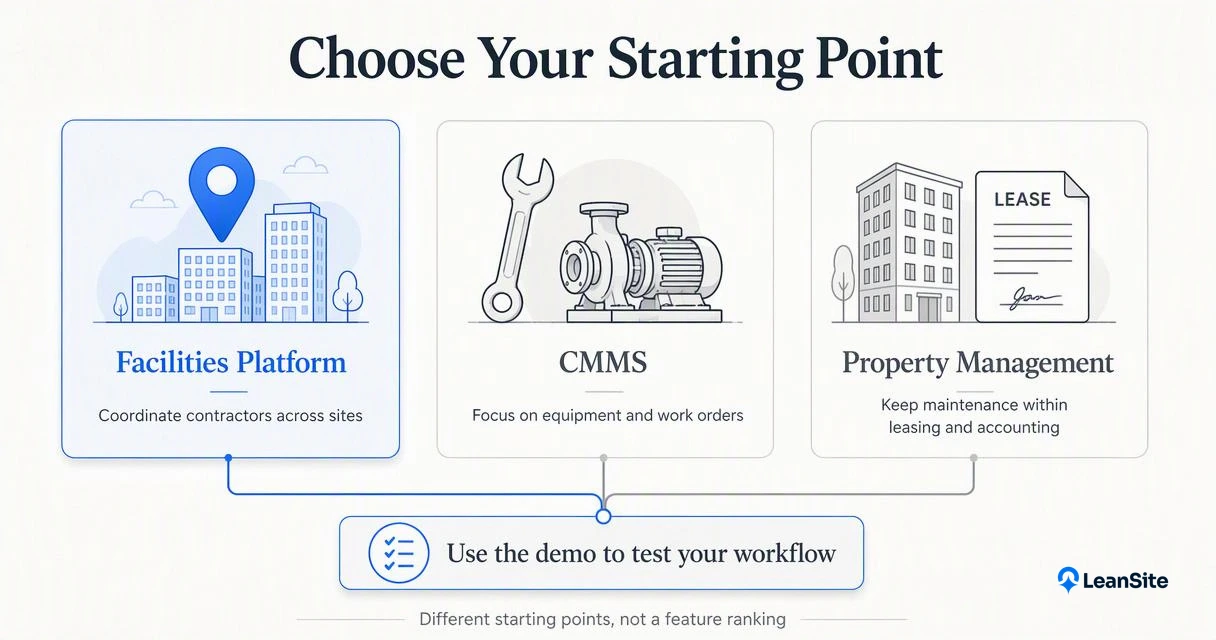
Compare platforms by operating focus
These options represent different starting points, not a verified feature-by-feature ranking.
| Platform | Starting focus | What the demo should establish |
|---|---|---|
| Leansite | AI-assisted facilities coordination | How the complete contractor workflow connects across sites |
| UpKeep | Maintenance requests, work orders, and building assets | External contractor access and owner reporting |
| MaintainX | Maintenance work execution | Vendor coordination, approval controls, and portfolio visibility |
| AppFolio | Property management with maintenance workflows | Fit for commercial operations and contractor invoice handling |
Availability, pricing, and integration details should be confirmed directly. The 2026 multi-site maintenance buying guide provides further evaluation context.
Who should pick which approach?
Facilities directors should prioritize cross-location coordination when many sites share contractors and approval rules. Asset-heavy teams should prioritize a CMMS when equipment history and preventive schedules drive daily work. Property managers should consider a property management suite when maintenance must connect closely with accounting.
For a deeper shortlist, the MaintainX alternatives guide offers related comparison context. The deciding test should remain the actual operating workflow, not the longest feature list.
How should teams build a controlled vendor workflow?
- Tier maintenance vendors by trade, coverage, and operational importance.
- Approve insurance, licenses, rates, and service areas before dispatch.
- Define response targets, escalation contacts, and spending authority.
- Assign work with access instructions and a clear scope.
- Verify completion evidence before approving invoices.
- Review performance by vendor, property, and trade.
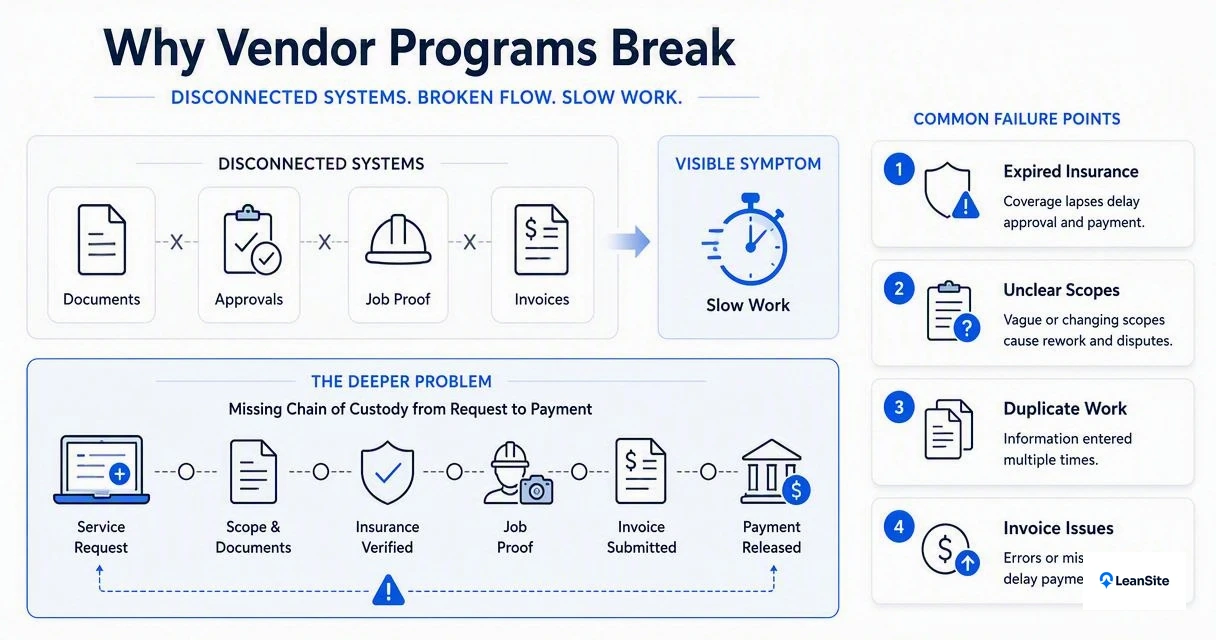
Keep compliance active during the job
Compliance controls should apply when work is assigned, not just when a contractor joins the directory. Software evaluations should check document-expiry reminders, eligibility rules, and whether subcontractor requirements can be recorded where relevant.
Consider an illustrative HVAC call with a $750 not-to-exceed limit. The dispatcher records the asset, approved contractor, access window, and spending cap. If the diagnosis changes the scope, approval should occur before extra work begins.
A closed work order should explain what was repaired, who verified it, and why the invoice was approved.
Track performance with clear definitions
Useful vendor measures separate speed, quality, and cost rather than combining everything into one score.
- Response time: Request creation to contractor acknowledgment.
- Completion time: Assignment to verified completion, with waiting periods identified.
- Repeat work: Jobs reopened for the same unresolved issue.
- Invoice accuracy: Charges matching approved scope, rates, and materials.
Emergency electrical repairs shouldn't be judged against routine landscaping visits. The vendor dispatch and predictive maintenance guide explores how dispatch connects with planned maintenance.
How Leansite handles this
Leansite approaches the topic through AI-assisted facilities management, making it relevant for teams evaluating coordinated maintenance operations. Its published material introduces Vera as an AI assistant built into the software. A practical demonstration should show how that assistance supports the contractor process, from request intake through documented completion.
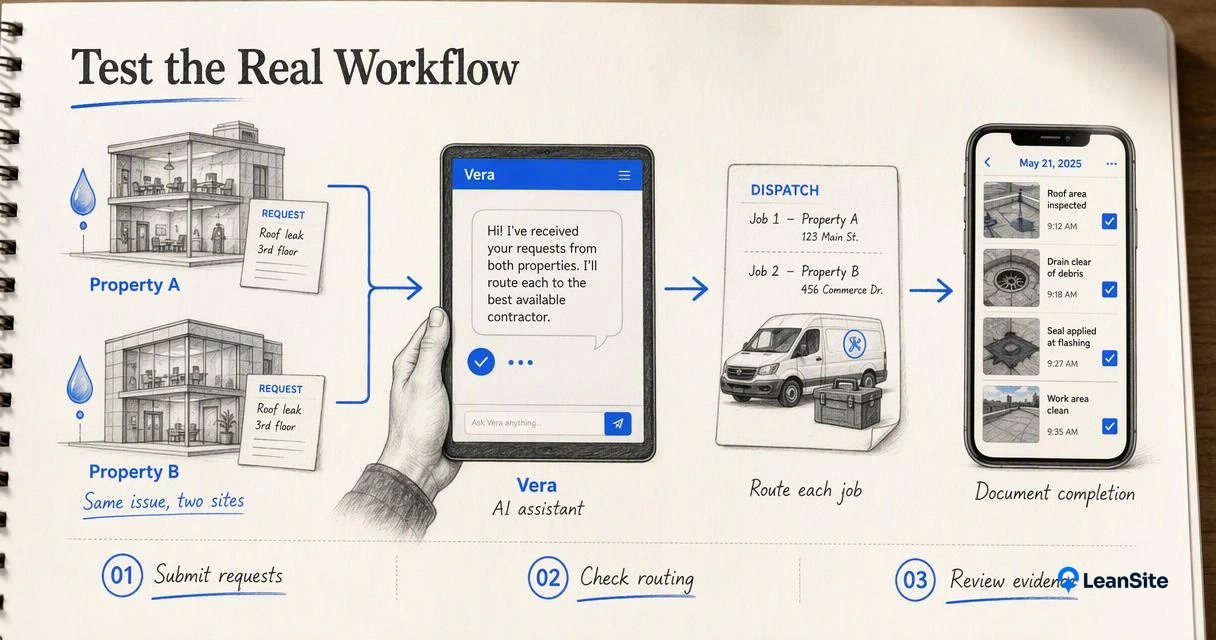
Run a property-level acceptance test
The Vera assistant overview provides product context. Buyers should then test a realistic scenario instead of relying on a scripted tour:
- Submit the same maintenance issue from two properties.
- Route each job according to trade and location.
- Record scope approval, contractor updates, and completion photos.
- Review the resulting history and spending information.
These are evaluation requirements, not claims that every function or integration is available in every plan. The test should include a site manager, contractor, and finance reviewer.
What to evaluate for 2027
AI-assisted coordination deserves a place in 2027 planning, with human approval retained for spending and contractor eligibility. Buyers should ask vendors to demonstrate traceable recommendations, role-based access, and exportable records. Those controls help make automation useful to both operations teams and auditors.
Commercial maintenance vendor software FAQs
Commercial teams should settle scope, payment responsibilities, and rollout requirements before selecting a platform.
Does a CMMS replace vendor management software?
A CMMS can cover vendor management when it supports contractor records, external access, approvals, and reporting. Work-order functionality alone doesn't establish that fit. During evaluation, teams should follow an outside contractor's job through assignment, scope changes, completion verification, and invoice review, rather than reviewing only internal technician workflows.
Can vendor software make contractor payments faster?
Vendor software can help payment workflows when completed work, approved charges, and invoice details reach finance together. Actual payment speed still depends on accounting procedures, payment terms, and integrations. Buyers should distinguish invoice approval from payment execution and confirm whether the platform processes payments or simply transfers approved records.
How should a commercial portfolio pilot new software?
A commercial portfolio should pilot software across properties with different maintenance needs, using real contractors and live jobs. Teams should define success criteria before launch, including assignment visibility, completion evidence, invoice accuracy, and reporting usefulness. A focused pilot also tests contractor participation, data migration, permissions, and support before portfolio-wide rollout.
Conclusion
Selecting vendor management software for commercial property maintenance starts with one complete workflow, not a feature checklist. Facilities leaders can visit getleansite.com to discuss Leansite, arrange a demonstration using a real maintenance scenario, and confirm contractor participation, approval controls, reporting, and commercial terms before choosing a pilot.