TL;DR
Commercial AC repair should be handled as an operations workflow, not just a service call. Triage the request, dispatch the right vendor, protect occupants and equipment, document costs, then use repair data to reduce repeat failures.
Air conditioning repair for commercial facilities affects comfort, uptime, revenue, tenant trust, and equipment life at the same time. A store, campus, office, restaurant, or healthcare site cannot treat a failed rooftop unit like a slow household inconvenience. The best teams run AC repair through a clear process: intake, triage, dispatch, communication, cost approval, closeout, and prevention.
Commercial HVAC repair: the diagnosis, servicing, repair, or replacement of cooling equipment used to control temperature, humidity, ventilation, and indoor air quality in business, institutional, and multi-site buildings.
For facilities teams that need work orders, vendor updates, photos, approvals, and closeout notes in one place, Leansite gives AC repair a shared operating record instead of scattered texts and invoices.
Table of Contents
What is air conditioning repair for commercial facilities?
Air conditioning repair for commercial facilities is the structured response to cooling failures in buildings that depend on HVAC for occupancy, equipment protection, code compliance, and business continuity. It includes troubleshooting, vendor dispatch, temporary mitigation, repair approval, documentation, and follow-up maintenance across assets such as rooftop units, split systems, chillers, controls, and economizers.
According to Wikipedia's HVAC definition, heating, ventilation, and air conditioning systems regulate temperature, humidity, and indoor air quality in buildings. Maintenance covers functional checks, servicing, repairing, or replacing necessary equipment and building infrastructure. In commercial operations, those two ideas meet inside the work order.
Key takeaway: A commercial AC repair is not complete when cold air returns. It is complete when the failure cause, labor, parts, vendor notes, tenant impact, photos, warranty status, and next preventive action are documented.
Common commercial cooling assets
Most facilities teams manage several cooling asset types, and each one changes the repair path.
- Rooftop units, or RTUs: common in retail, restaurants, offices, and light commercial buildings.
- Split systems: often used for small offices, server rooms, storage areas, and tenant spaces.
- Chillers: used in larger buildings, campuses, hospitals, and high-load facilities.
- Building automation controls: sensors, thermostats, schedules, relays, and control boards that can mimic mechanical failure.
- Ventilation components: dampers, economizers, belts, motors, and filters that affect cooling performance.
How should facility teams triage an AC repair request?
Facility teams should triage an AC repair request by confirming the affected area, checking occupant and asset risk, validating the symptom, assigning priority, dispatching the right trade, and recording every decision in the work order. A fast triage step prevents over-dispatching, missed emergencies, and vague vendor instructions.
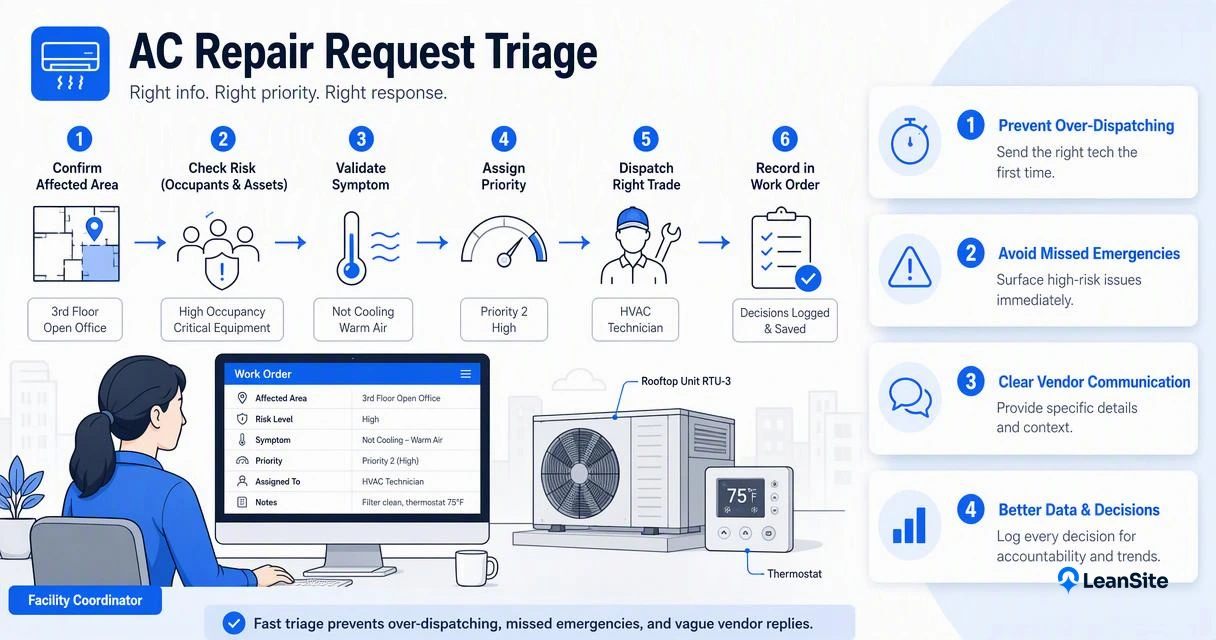
Quotable triage workflow
A strong commercial AC triage process looks like this:
- Capture the request: log location, unit, suite, zone, reported temperature, time, photos, and requester.
- Check life-safety or business risk: note medical areas, kitchens, server rooms, refrigerated inventory, events, or vulnerable occupants.
- Verify basics: confirm power, thermostat mode, schedule, breaker status, filter condition, and visible alarms when safe.
- Set priority: classify emergency, same-day, scheduled repair, or monitoring.
- Dispatch with context: send symptoms, access rules, asset ID, warranty notes, and site contact.
- Update stakeholders: give tenant, store, or department contacts a clear status and next expected update.
- Close with evidence: require cause, repair action, parts, readings, photos, cost, and recommended next step.
"An ounce of prevention is worth a pound of cure.", Benjamin Franklin, National Constitution Center
Priority table for commercial AC calls
| Priority | Typical trigger | Dispatch target | Facility action |
|---|---|---|---|
| Emergency | Heat risk, critical equipment, medical area, major tenant impact | Immediate | Escalate, notify leadership, consider temporary cooling |
| Same-day | Occupied zone above comfort range, customer-facing area, restaurant kitchen | Same business day | Dispatch vendor, update site contact, confirm access |
| Scheduled repair | Unit cooling weakly, recurring alarms, non-critical zone | Planned visit | Bundle related tasks if possible |
| Monitor | Intermittent complaint, controls question, no confirmed failure | Remote or next round | Track trend and document readings |
Multi-site teams gain the most from consistent triage rules because every location stops inventing its own definition of urgent. Related guidance on scaling that operating model appears in the complete guide to multi-location facilities management software.
Which repair issues deserve vendor dispatch?
Vendor dispatch is usually warranted when a commercial cooling issue involves refrigerant, electrical components, compressor faults, motor failure, controls diagnostics, repeated trips, or any work requiring licensed HVAC expertise. Facility staff can verify symptoms and access, but technical repair should stay with qualified commercial HVAC contractors.
Dispatch-ready symptoms
The best vendor tickets describe what changed, not just that "AC is broken." Useful symptoms include:
- Warm supply air from one zone while nearby zones cool normally.
- Unit short-cycling, running constantly, or not starting.
- Breaker trips, disconnect issues, burnt smells, or visible electrical damage.
- Condensate leaks, ice on coils, clogged drains, or water near ceiling tiles.
- Unusual vibration, belt noise, motor noise, or fan failure.
- Thermostat, sensor, or automation alarms tied to the affected equipment.
Technicians can arrive prepared when the work order includes asset ID, roof access notes, prior repair history, filter size, belt size, photos, and tenant hours. The Leansite platform supports that handoff by keeping work order notes, vendor communication, and closeout files tied to the same job record.
Helpful diagnostic video
The following technician-oriented video gives a plain-language overview of common cooling symptoms. It should support internal understanding, not replace licensed commercial HVAC work.
The main value for facility teams is vocabulary. Better descriptions reduce truck rolls, repeat visits, and time spent translating tenant complaints into technician-ready details.
How do teams control repair cost and documentation?
Teams control commercial AC repair cost by standardizing approvals, separating emergency work from quoted work, tracking repeat failures by asset, and requiring documented closeout before payment. Cost discipline comes from visibility, not from delaying repairs that protect occupants or revenue.
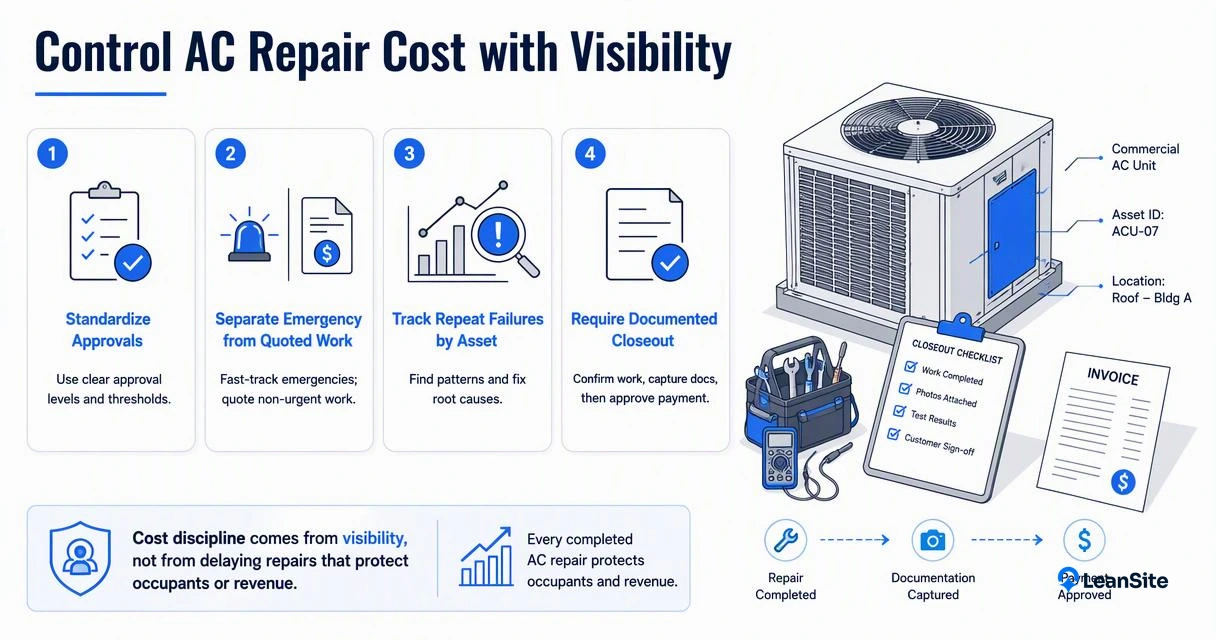
Repair closeout checklist
Every completed AC repair should leave behind enough detail for the next technician, manager, and property owner.
- Failure cause, not just repair performed.
- Labor hours, trip charge, parts, refrigerant, lifts, permits, and after-hours fees.
- Before-and-after photos when useful.
- Temperature readings, pressure readings, amperage, or control status when supplied by the contractor.
- Warranty status for parts and labor.
- Recommendation: monitor, preventive maintenance, capital replacement, or no further action.
- Invoice matched to approved scope.
"Without data, you're just another person with an opinion.", W. Edwards Deming, The W. Edwards Deming Institute
Repair history becomes powerful after enough work orders accumulate. Facility leaders can spot units with rising cost, vendors with repeat callbacks, and sites that need planned replacement instead of more patchwork. For more on that compounding value, see why year two is when facilities data finally proves its value.
Tenant and stakeholder updates
Commercial AC repair creates tension when occupants hear nothing. A simple communication cadence reduces calls and protects trust:
- Acknowledged: request received, zone identified, priority assigned.
- Dispatched: vendor assigned, estimated arrival shared.
- Diagnosed: issue identified, repair or quote status explained.
- Resolved or pending: outcome, temporary measures, and next update given.
- Closed: repair completed, comfort confirmed, documentation attached.
Campuses and large buildings often struggle because requesters cannot see status. The same principle is covered in work order transparency for campus facilities, where visibility matters as much as speed.
What changes for commercial AC repair in 2026?
Commercial AC repair in 2026 is becoming more data-driven, refrigerant-aware, and portfolio-focused. Facility teams now need repair records that support compliance, capital planning, vendor accountability, and faster decisions across many sites.
2026 trends affecting repair decisions
Three shifts matter most.
- Refrigerant transition: The U.S. Environmental Protection Agency's HFC phasedown program is pushing owners to pay closer attention to refrigerant type, leak history, and replacement timing.
- AI-assisted work intake: Modern tools can help categorize requests, summarize vendor notes, and flag repeat issues. Related context appears in AI facility management software.
- Multi-location benchmarking: Enterprises increasingly compare repair cost, response time, asset age, and vendor performance across regions.
Research on future connected systems, such as the 2023 IEEE paper On the Road to 6G, points toward denser sensor networks and faster machine communication. For facilities, the practical version is simpler: more equipment will report problems before occupants do.
With Leansite, facilities teams can organize those repair signals into one operational workflow instead of relying on inbox memory. More information is available at getleansite.com.
FAQ
How fast should a commercial AC repair be dispatched?
Emergency cooling issues should be dispatched immediately when they affect health, critical equipment, major revenue areas, or high-risk operations. Same-day dispatch usually fits occupied comfort complaints, restaurants, and customer-facing zones. Lower-risk issues can be scheduled when temperature remains stable and no business-critical area is affected.
Should facilities staff troubleshoot before calling an HVAC vendor?
Facilities staff can safely verify location, thermostat settings, schedules, power status, obvious alarms, filter condition, and access requirements. Refrigerant, compressor, electrical, motor, and control-board work should be handled by qualified commercial HVAC technicians. Good pre-checks improve dispatch quality without turning staff into repair contractors.
What should be included in a commercial AC repair work order?
A strong work order includes site, zone, asset ID, symptom, priority, photos, access notes, contact details, warranty status, vendor assignment, diagnosis, repair action, parts, readings, cost, invoice, and closeout recommendation. That record protects future troubleshooting and capital planning.
When should a facility replace instead of repair an AC unit?
Replacement becomes more likely when the same unit has repeated failures, rising repair cost, refrigerant issues, poor comfort performance, long parts delays, or major component failure near the end of service life. The decision should compare repair cost, downtime risk, energy performance, and planned capital timing.
Conclusion
Commercial AC repair works best when treated as a repeatable facility operations process. The next step is to standardize triage categories, require dispatch-ready work orders, set stakeholder update rules, and make closeout documentation mandatory before invoice approval.
For teams managing many sites, Leansite can help turn AC repair requests into trackable workflows with clearer vendor coordination and cleaner repair history. Head to getleansite.com to see how commercial maintenance teams can bring cooling repairs, costs, and closeout records into one place.