TL;DR
Planned maintenance is scheduled work with a defined scope, while preventive maintenance is recurring work meant to reduce breakdowns. A strong facility program uses both: planned work for organized execution, preventive work for risk reduction, and software to keep tasks, vendors, and assets visible.
Maintenance programs fail less from lack of effort than from unclear categories. The planned maintenance vs preventive maintenance discussion matters because one term describes how work gets organized, while the other describes why recurring work happens. For multi-site facilities, that difference affects budgets, uptime, vendor dispatch, and asset history. Leansite helps teams turn both categories into trackable work orders, so scheduled tasks do not disappear into email threads or spreadsheet tabs.
Table of Contents
What is planned maintenance vs preventive maintenance?
Planned maintenance is maintenance work scheduled with a known scope, labor plan, parts need, and timing, while preventive maintenance is recurring service designed to reduce failures before they happen. In short, planned maintenance is about control of execution; preventive maintenance is about avoiding equipment breakdowns.
Planned maintenance: scheduled work that has been identified, scoped, assigned, and prepared before execution.
Preventive maintenance: recurring inspection, servicing, repair, or replacement work performed at time-based or usage-based intervals to reduce the chance of failure.
Wikipedia defines maintenance as functional checks, servicing, repairing, or replacing equipment, infrastructure, and supporting utilities in industrial, business, and residential settings, according to Wikipedia's maintenance overview. That broad definition covers both planned and preventive work, but the operating intent is different.
Core comparison table
|
Category |
Planned maintenance |
Preventive maintenance |
|---|---|---|
|
Main question |
How should the work be organized? |
How can failure risk be reduced? |
|
Trigger |
Work is identified and scheduled |
Time, usage, condition, or compliance interval |
|
Examples |
Replace a rooftop unit belt next Tuesday; schedule parking lot light repair |
Monthly HVAC filter changes; quarterly fire pump inspection |
|
Frequency |
One-time or recurring |
Usually recurring |
|
Best metric |
Schedule compliance, backlog age, labor readiness |
Failure rate, asset uptime, repeat repairs |
|
Main risk if ignored |
Work becomes chaotic or delayed |
Assets fail more often and cost more to run |
Planned work creates order. Preventive work reduces risk. The strongest facility teams treat them as overlapping categories, not competing strategies.
A simple way to remember the difference
A preventive task can also be planned, but not every planned task is preventive. For example, a scheduled repair to replace a broken door closer is planned maintenance because the work is organized in advance. A monthly inspection of all door closers is preventive maintenance because the goal is to catch wear before tenant complaints, safety issues, or access problems appear.
"An ounce of prevention is worth a pound of cure.", Benjamin Franklin, Founders Online
When should facilities use planned maintenance?
Facilities should use planned maintenance whenever work can be scoped before execution, especially when parts, access windows, vendor scheduling, or tenant communication affect the job. It works best for known repairs, capital replacements, compliance visits, shutdown work, and non-emergency tasks that need coordination.
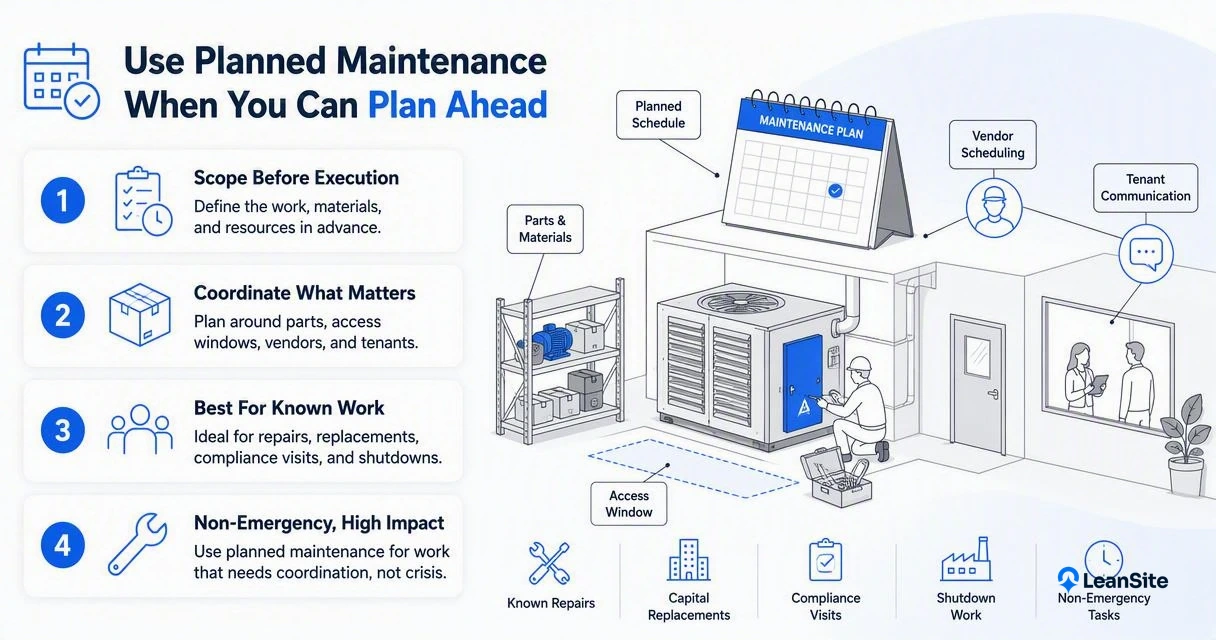
Planned work is the antidote to guessing. A facilities director may know that three exterior lights failed, but the real plan includes lift rental, electrician availability, fixture model numbers, safety cones, and after-hours access. Without that prep, a small job can require two or three trips.
Common planned maintenance examples
-
Roof leak repair: inspection photos, vendor quote, tenant access, and weather window are gathered before work starts.
-
Elevator modernization: the scope, downtime notices, permits, and contractor milestones are scheduled weeks ahead.
-
Parking lot striping: work is planned around store traffic, weather, and blocked-off zones.
-
Asset replacement: a failing water heater is replaced during a low-traffic period before it disrupts operations.
Deferred maintenance is the practice of postponing repairs or upkeep to save costs, meet budgets, or shift resources, according to Wikipedia's deferred maintenance definition. Planned maintenance helps prevent normal backlog from becoming deferred work. For a deeper cost view, see the hidden cost of deferred maintenance.
Best-fit signals for planned work
Planned maintenance belongs in the program when at least one of these conditions exists:
-
The task is known but not urgent.
-
Parts or tools must be ordered.
-
A vendor must be dispatched.
-
Downtime must be approved.
-
Tenants, store managers, or site leaders need notice.
-
Work history should be tied to an asset record.
Multi-location teams also need planned work when several sites require the same campaign, such as backflow testing or signage repairs. Strong visibility matters more as portfolios grow, which is why teams often study how to manage maintenance across multiple locations without losing visibility.
When should facilities use preventive maintenance?
Facilities should use preventive maintenance for assets where routine care can reduce breakdowns, safety risk, energy waste, or compliance exposure. HVAC systems, fire life safety equipment, refrigeration, plumbing components, elevators, doors, lighting controls, and production support equipment are common candidates.
Preventive tasks need a clear interval and a specific checklist. A vague reminder such as inspect HVAC is weak. A stronger task says: replace filters, inspect belts, check drain pans, record supply and return temperatures, and attach photos before closing the work order.
Preventive maintenance workflow
-
Build an asset list with location, model, serial number, and service priority.
-
Assign intervals based on manufacturer guidance, code requirements, usage, and operating history.
-
Create task checklists with pass-fail fields, readings, photos, and notes.
-
Schedule work before peak demand periods.
-
Route vendor tasks with clear scope and site access instructions.
-
Review missed tasks, repeat failures, and cost trends monthly.
A practical digital setup is covered in how to build a preventive maintenance ticket flow, especially for teams moving from calendar reminders to structured work orders.
Preventive maintenance training video
Although the video focuses on pharmaceutical equipment, the operating lesson applies to commercial facilities: recurring tasks need documentation, accountability, and proof of completion. Regulated environments make this obvious, but retail, office, healthcare, and industrial properties also benefit from tighter records.
How should both strategies work together in 2026?
In 2026, facilities should combine planned and preventive maintenance inside one workflow: preventive tasks generate recurring work, planned maintenance organizes execution, and asset history shows whether the program is reducing failures. The goal is not more tickets; the goal is better-timed work with less surprise downtime.
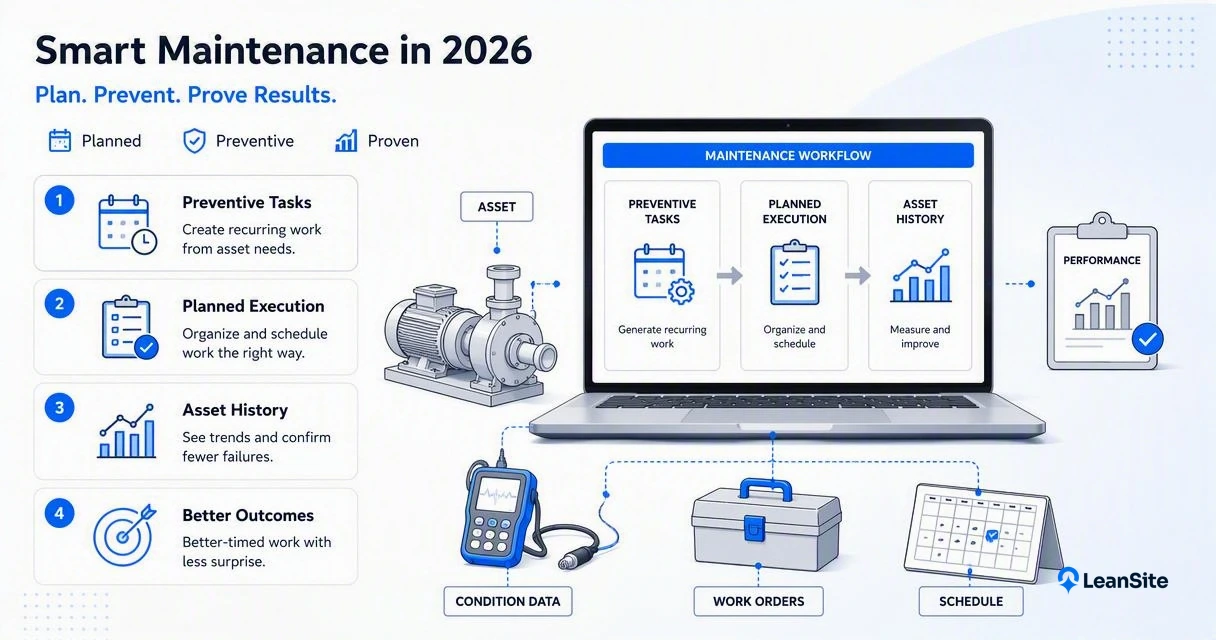
The Leansite platform supports that combined model by turning recurring schedules, vendor dispatch, site notes, and task status into visible work. That matters for enterprise operations teams managing dozens or hundreds of locations because a clean program needs both repeatable standards and local execution detail.
Program design for multi-site teams
|
Program layer |
Purpose |
Example |
|---|---|---|
|
Asset register |
Defines what needs care |
HVAC units, grease traps, fire panels |
|
Preventive schedule |
Defines recurring risk-reduction work |
Quarterly HVAC service |
|
Planned work order |
Defines execution details |
Vendor, date, parts, access notes |
|
Vendor workflow |
Controls outside labor |
Dispatch, acceptance, photos, invoice status |
|
Reporting |
Shows whether the program works |
Missed PMs, repeat repairs, cost by asset |
Vendor coordination becomes a major difference-maker once preventive work crosses regions. Dispatch automation, predictive triggers, and work verification are explained further in vendor dispatch and predictive maintenance automation for multi-site teams.
What to expect in 2027
Maintenance programs are moving from calendar-only schedules toward condition-aware planning. Sensors, meter readings, technician notes, and vendor photos will increasingly shape when work gets scheduled. Preventive maintenance will not disappear, but more tasks will shift from fixed intervals to risk-based intervals.
"It is not necessary to change. Survival is not mandatory.", W. Edwards Deming, The W. Edwards Deming Institute
Software selection will matter more as portfolios become more distributed. Buying teams comparing tools can review best multi-site maintenance software in 2026 for factors such as site visibility, vendor workflows, and reporting depth.
FAQ about planned and preventive maintenance
Planned and preventive maintenance often overlap, so the clearest answers focus on task intent, scheduling, and asset risk. These quick definitions help facility managers, owners, and operations leaders label work correctly and build cleaner reports.
Is preventive maintenance always planned?
Preventive maintenance should almost always be planned because recurring service needs a schedule, checklist, owner, and completion record. A preventive task without planning usually becomes a loose reminder. The better setup creates a work order before the due date, assigns labor or a vendor, and captures proof of completion.
Can planned maintenance be reactive?
Planned maintenance can follow a reactive event. For example, a leak may be discovered during an emergency call, but the permanent ceiling repair can be scoped, scheduled, and assigned later. The first response is reactive, while the follow-up repair becomes planned once timing, labor, and materials are organized.
Which maintenance type reduces cost more?
Preventive maintenance usually has the clearer cost-reduction goal because it aims to reduce failures, emergency labor, and asset damage. Planned maintenance reduces cost differently by improving coordination, reducing repeat trips, and avoiding rushed purchasing. Most facilities need both to control operating expense.
How often should preventive maintenance be scheduled?
Preventive maintenance intervals should reflect manufacturer guidance, code requirements, asset condition, usage, and business impact. A lightly used exhaust fan may need less frequent service than a rooftop unit serving a busy restaurant. Teams should adjust intervals when inspection results show repeated issues or unnecessary visits.
Conclusion
Planned maintenance vs preventive maintenance is not a choice between two rival methods. Planned maintenance brings structure to known work, while preventive maintenance creates recurring protection for important assets. A practical next step is to audit the current work order list, label each task as reactive, planned, preventive, or deferred, then rebuild schedules around the assets with the highest uptime and cost impact. For teams ready to standardize that process across locations, Leansite and getleansite.com offer a focused path for turning maintenance plans into visible, accountable work.