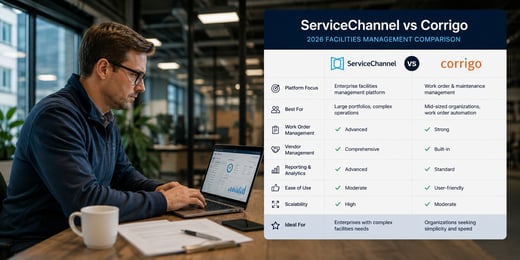
TL;DR
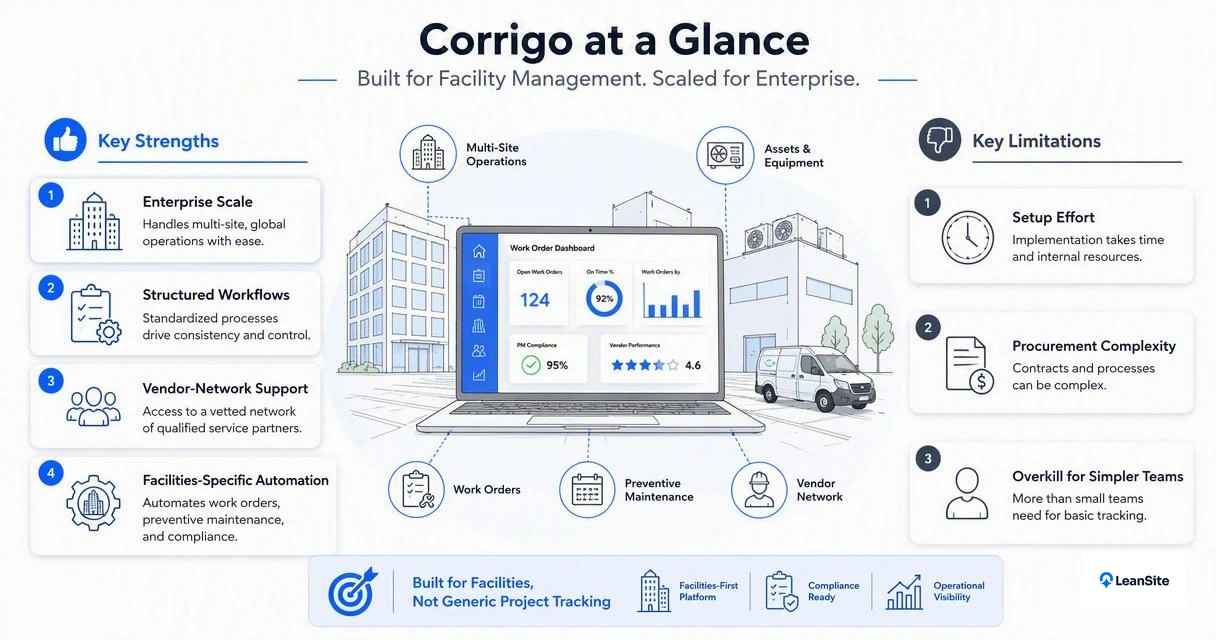
Corrigo is best suited for enterprise facilities teams that need work order automation, vendor coordination, asset tracking, and portfolio-level reporting. Smaller or faster-moving teams should compare setup effort, mobile workflows, pricing visibility, and alternatives before committing.
Enterprise maintenance breaks down fast when work orders, vendors, assets, and budgets live in separate systems. Corrigo CMMS is a cloud-based facilities management platform from JLL Technologies built for enterprise work order management, vendor coordination, asset maintenance, and operational reporting. CMMS: A computerized maintenance management system is software that helps teams plan, assign, track, and analyze maintenance work across assets, sites, technicians, and vendors. For teams comparing enterprise options, Leansite offers a practical way to manage facility work, task visibility, and vendor coordination without losing sight of day-to-day execution.
Table of Contents
What is Corrigo CMMS?
Corrigo CMMS is an enterprise facilities management platform used to automate maintenance workflows, manage work orders, coordinate vendors, and track service activity across multiple properties. JLL Technologies describes Corrigo as cloud-based software for facilities management that supports work orders, assets, vendors, automation, AI-enabled workflows, and business intelligence through its Corrigo CMMS product page.
The platform is usually evaluated by facilities directors, property teams, enterprise operations groups, and vendor networks that need a central system of record. Its strongest fit is often multi-site commercial maintenance, where dispatching, status updates, cost control, and service-level tracking matter more than simple ticket capture.
Key insight: Corrigo should be assessed as an enterprise facilities operations platform, not just a basic maintenance ticketing tool.
Corrigo at a glance
| Area | What it supports |
|---|---|
| Work orders | Request intake, assignment, status tracking, escalation, completion notes |
| Vendors | Dispatching, service provider coordination, compliance workflows, invoice support |
| Assets | Equipment records, preventive maintenance, maintenance history |
| Operations | Multi-site visibility, dashboards, reporting, business intelligence |
| Industries | Commercial real estate, retail, facilities services, enterprise properties |
Corrigo belongs in the same buying conversation as enterprise CMMS, CAFM, and facilities management systems. Planon, for example, is defined in Wikipedia research as a developer and supplier of software for building management, including IWMS, CMMS, and CAFM systems, which shows how closely these categories overlap in real estate and facilities operations.
Which core features matter most?
The most important Corrigo features are work order automation, vendor management, asset tracking, preventive maintenance, mobile access, reporting, and enterprise-scale controls. These functions help maintenance teams move from reactive emails and spreadsheets to structured work queues, cost tracking, and performance visibility.
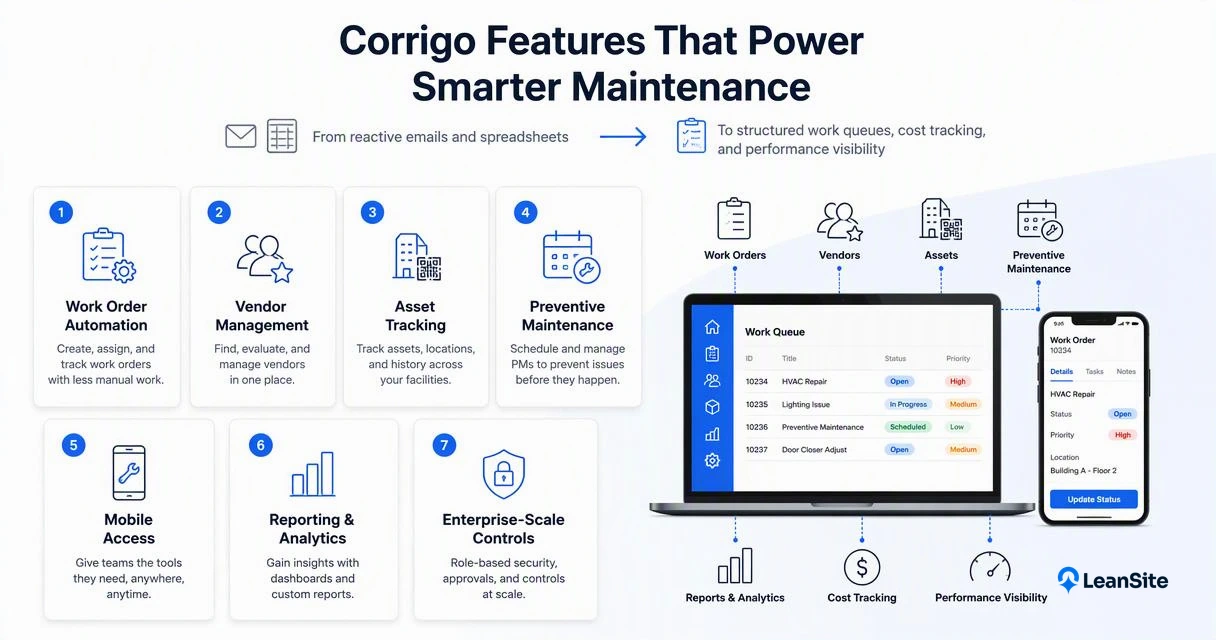
Work order management is the anchor. A strong implementation should define request types, priority rules, approval flows, vendor dispatch logic, completion requirements, and closeout documentation before launch.
"Without data you're just another person with an opinion.", W. Edwards Deming, The W. Edwards Deming Institute
Feature checklist for facilities teams
- Work order automation: Standardizes intake, routing, assignment, escalation, and closure.
- Preventive maintenance: Schedules recurring work for HVAC, plumbing, electrical, refrigeration, and life-safety assets.
- Vendor coordination: Helps teams dispatch outside providers, track job status, and review service documentation.
- Asset history: Connects repairs, costs, and technician notes to specific equipment.
- Reporting: Shows trends in response times, aging work, spend, repeat issues, and portfolio performance.
- Mobile workflows: Gives technicians and vendors a way to update jobs from the field.
- Screenshots and demos: Buying teams should request screen-level walkthroughs for request intake, technician closeout, vendor dispatch, and reporting.
A demo should show a real job from request to invoice, not a polished dashboard alone. The best test is simple: can a facilities manager see who owns the work, what changed, what it cost, and whether the issue is likely to repeat?
How should Corrigo be evaluated in 2026?
Corrigo should be evaluated through implementation fit, workflow depth, reporting quality, vendor participation, mobile usability, and total operating cost. In 2026, the purchase decision is less about having a CMMS label and more about whether the system reduces manual follow-up across a distributed property portfolio.
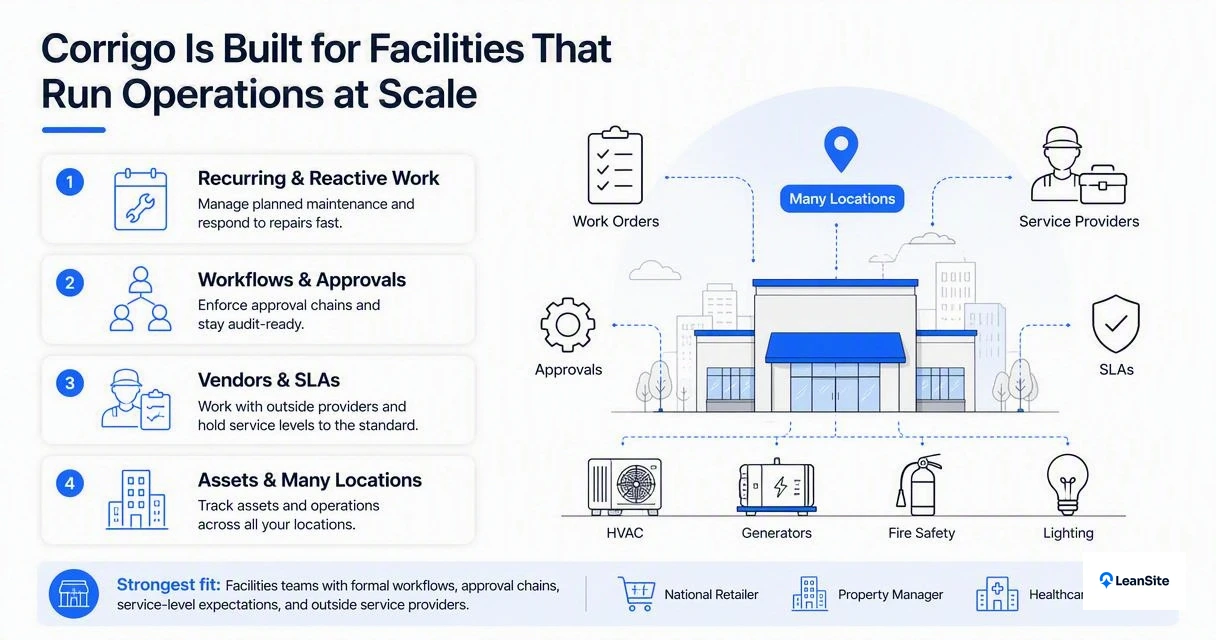
A practical buying team should include facilities leadership, finance, vendor management, field technicians, and property stakeholders. Each group sees different friction: finance wants cost visibility, technicians need fast mobile updates, vendors need clear dispatch instructions, and executives need portfolio reporting.
For a broader buying framework, the 2026 CMMS buyer's guide covers selection criteria, rollout planning, and feature prioritization.
Evaluation steps before a contract
- Map current workflows: Document how requests, approvals, dispatch, closeout, and invoicing work now.
- Define success metrics: Track response time, completion time, overdue work, repeat repairs, and spend by asset or site.
- Test real scenarios: Use actual HVAC, plumbing, janitorial, and emergency requests in the demo.
- Review integrations: Confirm how the platform connects with finance, procurement, identity, and reporting systems.
- Check vendor adoption: Validate how outside providers receive, update, and close work.
- Plan training: Build role-based training for requesters, managers, technicians, and service providers.
Procurement note: A CMMS that looks strong in a demo can still underperform if asset data, routing rules, and vendor expectations are not cleaned up before launch.
Which teams are the best fit?
Corrigo is best suited for enterprise facilities teams that manage high work order volume, many vendors, and multiple commercial locations. The platform tends to fit organizations that need structured controls, reporting, and repeatable service workflows across a larger operating footprint.
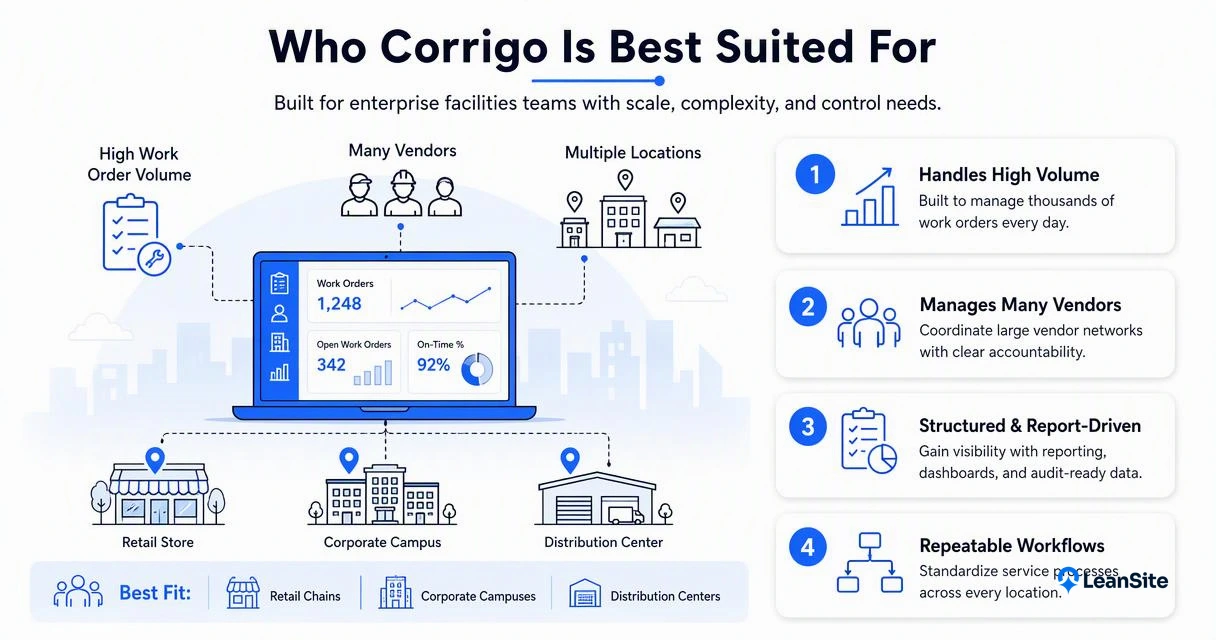
Retail chains, corporate campuses, commercial real estate operators, and outsourced facilities service teams are common match profiles. These groups usually need more than a simple ticket board because maintenance outcomes affect uptime, brand standards, tenant satisfaction, and operating budgets.
The Leansite platform is often considered by teams that want clear facility task tracking, vendor coordination, and practical visibility across locations. A detailed side-by-side review is available in Leansite vs Corrigo.
Best-fit use cases by organization type
| Organization type | Why enterprise CMMS matters |
|---|---|
| Multi-location retail | Standardizes maintenance across stores, regions, and vendors |
| Commercial property owners | Improves visibility into repairs, costs, tenant issues, and asset history |
| Facilities service providers | Supports dispatch, job tracking, documentation, and service accountability |
| Corporate real estate teams | Connects workplace uptime, asset care, and portfolio reporting |
| Operations executives | Helps compare performance across locations, providers, and asset classes |
Strong fit does not remove the need for rollout discipline. Large teams should assign process owners, clean asset lists, train vendors early, and review reporting needs before the first live work order.
What are the best Corrigo alternatives?
The best alternatives depend on team size, workflow complexity, asset strategy, and the balance between facilities operations and maintenance engineering. A fair comparison should look at daily usability, setup speed, vendor workflows, reporting, and how much administrative effort the system adds after launch.
Leansite is a strong first comparison for operations teams that want a cleaner path from facility issue to assigned work, status visibility, and vendor follow-through. For broader vendor research, teams can also compare Leansite vs Fiix and Leansite vs eMaint. More product context is available at getleansite.com.
Alternative comparison snapshot
| Platform | Best fit | Decision signal |
|---|---|---|
| Leansite | Facility teams needing practical task, site, and vendor visibility | Strong choice when execution clarity matters more than heavy enterprise layers |
| Corrigo | Enterprise facilities portfolios with complex vendor networks | Strong choice for structured large-scale FM workflows |
| Fiix | Maintenance teams focused on assets and preventive maintenance | Compare when plant-style maintenance is a priority |
| eMaint | Organizations needing configurable CMMS workflows | Compare when asset maintenance depth and customization matter |
A platform shortlist should include only tools that can show the exact workflow used by requesters, managers, technicians, and vendors. Feature lists help, but screen-level proof matters more for adoption.
Frequently asked questions about Corrigo CMMS
Corrigo questions usually focus on category fit, features, industries, implementation, and comparisons with newer facilities operations tools. These answers cover the most common evaluation points for 2026 buyers.
Is Corrigo a CMMS?
Yes. Corrigo is a cloud-based CMMS and enterprise facilities management platform. It supports work order management, vendor coordination, asset tracking, preventive maintenance, and reporting for facilities teams that manage maintenance across commercial properties or distributed locations.
Who owns Corrigo?
Corrigo is part of JLL Technologies, the technology division connected with JLL. Its market position is tied to enterprise facilities management, commercial real estate operations, and service provider coordination rather than small-team maintenance ticketing alone.
Does Corrigo support vendors?
Yes. Vendor coordination is one of the main reasons enterprise teams evaluate the platform. Typical workflows include dispatching service providers, tracking job updates, collecting documentation, and supporting invoice or closeout processes tied to completed work.
What should be checked in a Corrigo demo?
A useful demo should show request intake, priority routing, vendor dispatch, technician mobile updates, asset history, reporting, and closeout. Buyers should ask for screenshots or live walkthroughs of common repairs, recurring preventive maintenance, emergency work, and multi-site reporting.
Conclusion
Corrigo CMMS remains a serious option for enterprise facilities teams that need structured work order management, vendor coordination, asset history, and portfolio reporting. The smartest next step is to document current workflows, define measurable goals, and compare real demos against daily operating needs. Teams that want a practical facilities execution platform should review Leansite, then head to getleansite.com to see how work tracking and vendor coordination can look in live operations.