TL;DR
Vendor management software should cover the full contractor lifecycle: dispatch, quote approvals, job proof, compliance, invoice review, and scorecards. Commercial property teams should favor tools that connect vendor work to assets, locations, costs, and service history, not just contact lists.
Vendor management software for commercial property maintenance has become the operating layer between service requests, outside trades, asset uptime, and cost control. A vendor is an enterprise that contributes goods or services in a supply chain, while a vendor management system is commonly defined as a web-based application for managing and procuring outside services, according to Wikipedia's VMS definition. For property owners and facility teams, that means one place to assign jobs, approve quotes, verify insurance, track work, and review invoices. Leansite fits this need for multi-location maintenance teams that need vendor dispatch, task visibility, and portfolio-level operating control.
Table of Contents
What is vendor management software for commercial property maintenance?
Vendor management software for commercial property maintenance is a digital system that manages outside contractors from onboarding through payment and performance review. It connects work orders, vendors, documents, approvals, invoices, and reporting so commercial property teams can see who did the work, where it happened, what it cost, and whether it met standards.
Vendor management software: A web-based platform that helps facility and property teams source, dispatch, document, monitor, and pay third-party service providers.
The category overlaps with maintenance management software, project management software, and procurement tools. The difference is context. Commercial maintenance depends on urgent dispatch, recurring inspections, local trade coverage, site access rules, insurance documents, and proof of completed work.
Key insight: A vendor database is not a vendor management system. The system must manage the work, documents, approvals, and outcomes tied to each contractor.
Lifecycle checklist table
|
Vendor lifecycle stage |
What the software should track |
Why it matters |
|---|---|---|
|
Onboarding |
W-9, insurance, trade type, service area |
Reduces compliance gaps before work starts |
|
Dispatch |
Location, asset, priority, SLA, scope |
Sends the right vendor to the right job |
|
Quotes |
Photos, line items, approval notes |
Controls spend before repairs begin |
|
Work proof |
Timestamps, notes, images, technician updates |
Creates an audit trail for owners and tenants |
|
Invoice review |
Approved quote, work order, cost codes |
Prevents mismatched billing |
|
Scorecards |
Response time, completion quality, callbacks |
Supports better vendor selection |
Which features matter most in 2026?
The most useful platforms in 2026 manage the full vendor lifecycle, not just work order assignment. Facility teams should look for dispatch automation, quote routing, compliance tracking, field documentation, invoice matching, and scorecards that compare vendors across buildings, regions, and trades.
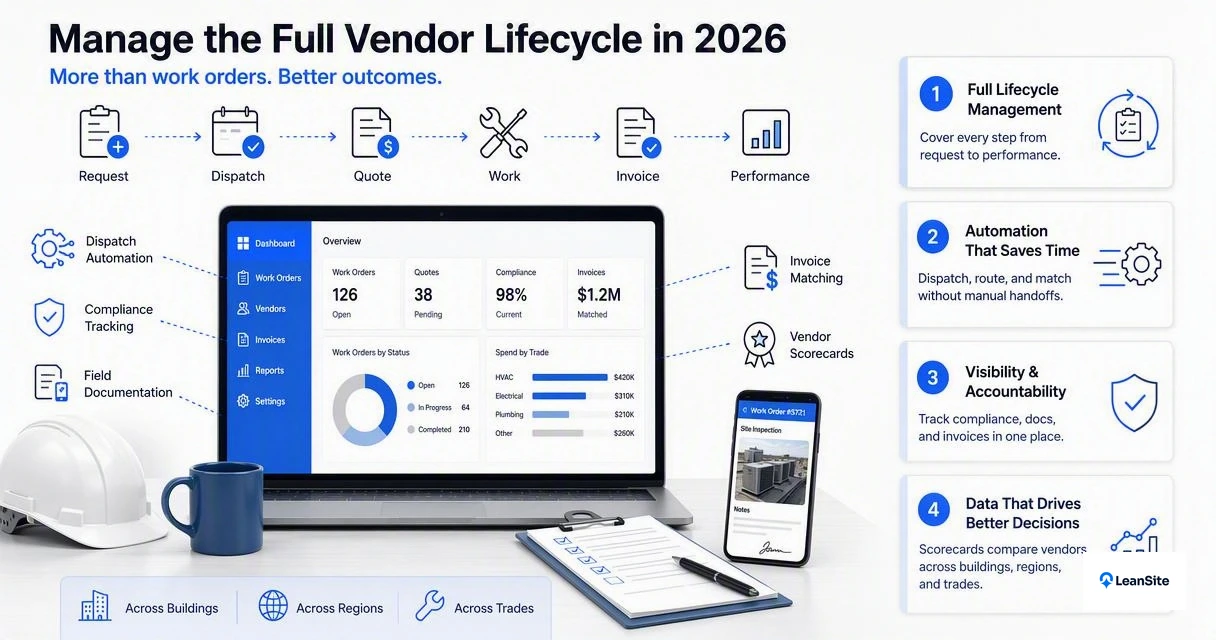
Research on digitalization in practice notes that organizations gain value when digital tools change workflows, not just records. The 2022 study Tackling the digitalization challenge highlights the practical need to connect technology to operating models, not treat software as a standalone fix (International Journal of Information Systems and Project Management).
For commercial maintenance, the highest-value features usually sit in the handoffs between teams. A plumbing vendor may need a dispatch text, a manager may need quote approval, accounting may need invoice backup, and ownership may need cost visibility by asset.
-
Smart dispatching: Route work by trade, location, urgency, and availability.
-
Quote approval workflows: Set approval thresholds by cost, property, or manager.
-
Compliance records: Store certificates of insurance, licenses, expiry dates, and vendor status.
-
Job documentation: Capture photos, notes, timestamps, and completion details.
-
Invoice matching: Compare invoices against approved scope and completed work.
-
Performance scorecards: Rank vendors by response time, callback rate, cost, and quality.
The Leansite platform is especially relevant for teams coordinating outside trades across several commercial sites. Related workflows are covered in more depth in vendor dispatch and predictive maintenance automation for multi-site teams.
Helpful video overview
How should commercial teams evaluate platforms?
Commercial property teams should evaluate platforms by workflow fit, portfolio visibility, vendor controls, mobile documentation, integrations, and reporting depth. A good buying process starts with the maintenance lifecycle, then tests whether each system can handle real jobs from request to invoice without side spreadsheets.
Competitor search results often compare property software brands such as NetVendor, Jones, Entrata, DoorLoop, Hemlane, PayHOA, Rent Manager, ResMan, and Vendoroo. Those comparisons are useful, but commercial maintenance buyers need a sharper filter than brand recognition alone.
"Without data, you're just another person with an opinion.", W. Edwards Deming, The W. Edwards Deming Institute
A practical evaluation should include live scenarios. For example, a roof leak at Building 4 should generate a work order, route to an approved roofer, attach photos, request a quote, trigger approval, document repair, and match the invoice.
-
Map the current vendor workflow from request to payment.
-
List required trades, service areas, and approval rules.
-
Test dispatch and quote approvals with real examples.
-
Review compliance record handling and expiration alerts.
-
Check reporting by property, asset, vendor, and cost code.
-
Confirm mobile access for vendors and maintenance coordinators.
-
Ask how data exports work if the contract ends.
For larger portfolios, multi-location facilities management software is often the better lens than generic property management software. Maintenance teams may also compare options using multi-site maintenance software buying criteria.
Platform evaluation table
|
Evaluation area |
Strong signal |
Weak signal |
|---|---|---|
|
Dispatch |
Vendors get clear scope, site details, and priority |
Jobs are assigned by email only |
|
Compliance |
Insurance and licenses have status and expiry tracking |
Documents sit in shared folders |
|
Approvals |
Quote rules match property authority limits |
Every quote needs manual chasing |
|
Documentation |
Photos and notes attach to the job record |
Proof of work lives in text threads |
|
Reporting |
Costs roll up by asset, vendor, site, and region |
Reports show only open and closed tasks |
Where do vendor programs usually break?
Vendor programs usually break when documents, approvals, job proof, and invoices live in separate systems. The visible symptom is slow work. The deeper problem is a missing chain of custody from the first service request to the final payment.
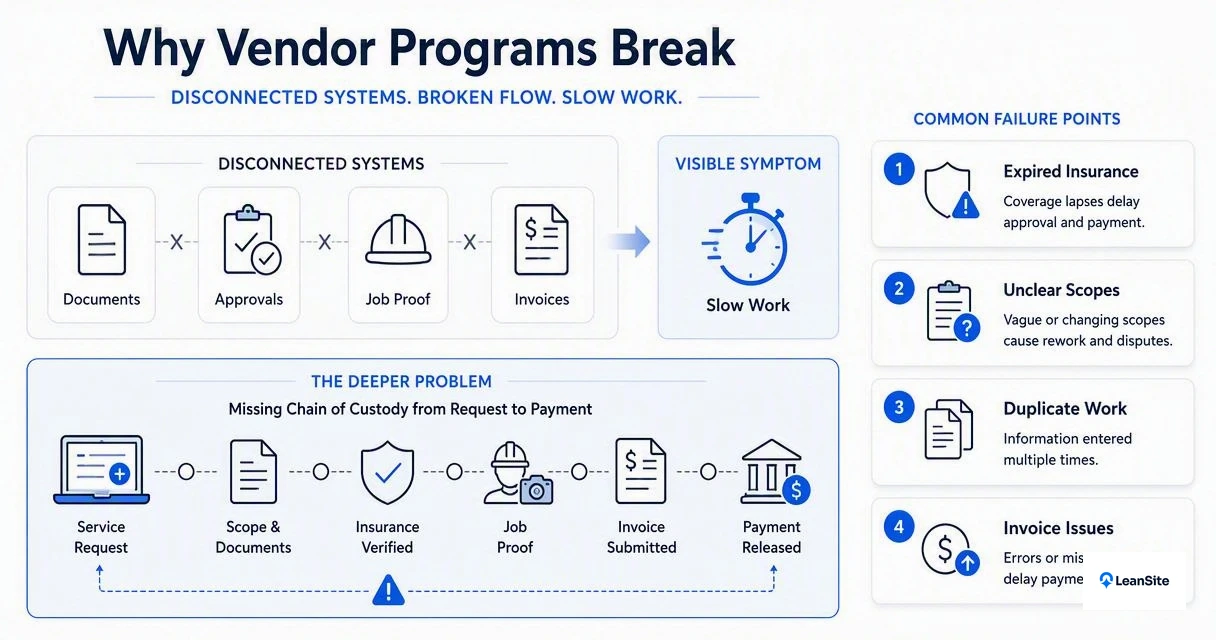
Common failure points include expired insurance, unclear scopes, duplicate dispatches, quote approvals stuck in email, incomplete photo records, and invoices that do not match approved work. These issues are more likely across multi-location portfolios because each site may have different managers, preferred vendors, and local requirements.
"Management is doing things right; leadership is doing the right things.", Peter F. Drucker, The Drucker Institute
A strong system does not remove judgment from facilities work. It gives managers cleaner facts before making decisions. Vendor scorecards, for example, should not punish a specialist for complex work; they should reveal patterns such as late arrivals, repeated callbacks, or above-market pricing.
-
Compliance risk: Missing insurance creates exposure before anyone reaches the job site.
-
Cost leakage: Unapproved extras and vague invoices raise operating costs.
-
Poor accountability: No photos or timestamps makes dispute resolution harder.
-
Vendor overload: The same contractor may receive every job because no one can compare alternatives.
-
Portfolio blind spots: Owners see total maintenance spend but not the vendor behavior behind it.
Teams that work in areas with weak connectivity should also consider offline access. The maintenance scenarios in industries that need offline maintenance software show why field documentation cannot depend on perfect signal strength.
What will change next in vendor maintenance software?
Vendor maintenance software will become more predictive, more automated, and more conversational through 2027. The biggest shift is from recording completed jobs to recommending the next best action based on asset history, vendor performance, seasonality, and failure patterns.
AI will not replace the local knowledge of experienced facility managers. It will help sort noisy work orders, flag missing documentation, summarize vendor histories, and suggest preventive tasks. Leansite's AI direction is a good example of how facility platforms are moving from static task lists toward guided decision support, including the work described in AI facility management software.
Predictive maintenance also matters because vendor management and asset uptime are linked. A rooftop unit failure is not just an HVAC issue; it affects vendor dispatch, tenant comfort, invoice review, and capital planning. The benefits of shifting from reactive to predictive work are covered in maximizing facility uptime with predictive maintenance.
The next wave of platforms will likely prioritize:
-
Automated vendor recommendations by trade, location, and past performance.
-
AI summaries of job notes, photos, and invoice backup.
-
Expiration alerts for compliance documents before dispatch.
-
Preventive work suggestions tied to asset history.
-
Portfolio benchmarking across regions and property types.
For teams ready to modernize vendor operations, getleansite.com is a practical starting point for seeing how maintenance workflows, vendor dispatch, and operating visibility can sit in one system.
FAQ
Vendor management software questions usually center on scope, cost control, compliance, and how these systems differ from basic work order tools. The answers below focus on commercial property maintenance teams managing outside trades across multiple assets or locations.
Is vendor management software different from work order software?
Vendor management software is broader than basic work order software when it handles onboarding, compliance, quotes, dispatch, work proof, invoice review, and performance scorecards. Work order tools mainly track tasks. Vendor-focused platforms connect those tasks to contractor records, documents, pricing, approvals, and service quality.
Which commercial properties benefit most from vendor management tools?
Multi-tenant offices, retail centers, industrial sites, healthcare properties, self-storage portfolios, and national brand locations benefit most. These properties usually rely on many outside trades, including HVAC, plumbing, electrical, roofing, janitorial, landscaping, fire safety, and general maintenance vendors.
How does software improve invoice review?
Software improves invoice review by linking the invoice to the original work order, approved quote, photos, technician notes, completion time, and cost code. That record helps accounting and facilities teams spot mismatched amounts, missing documentation, duplicate charges, or work billed outside the approved scope.
When should a team move beyond spreadsheets?
A team should move beyond spreadsheets when vendor records, insurance documents, quote approvals, and job updates are difficult to trust or keep current. Spreadsheets can track names and phone numbers, but they rarely manage live dispatch, document expiration, mobile proof of work, or portfolio-level reporting.
Conclusion
The best vendor management software for commercial property maintenance gives owners and facility teams one reliable chain of record from vendor onboarding to payment review. The right platform should prove compliance, speed up dispatch, control quotes, document field work, and show which vendors protect uptime across the portfolio. For teams comparing options in 2026, the next step is simple: map three real vendor jobs, test each workflow end to end, and visit getleansite.com to see how Leansite supports modern commercial maintenance operations.