TL;DR
Work order SLA tracking works best when every request has a priority, owner, response target, completion target, and escalation rule. Facility teams should start with a simple priority matrix, report overdue trends weekly, and use software that connects technicians, vendors, assets, and locations in one workflow.
Missed maintenance deadlines rarely start as big failures; they usually start as unclear ownership, vague priorities, and work orders that no one sees until they are overdue. Work order SLA tracking facility management gives facility teams a practical way to protect uptime, control vendor performance, and show property leaders where service delays actually happen. Platforms such as Leansite help multi-location teams turn those service commitments into trackable work, alerts, and reporting instead of scattered emails and spreadsheets.
Table of Contents
What is work order SLA tracking in facility management?
Work order SLA tracking in facility management is the process of measuring each maintenance request against agreed response, resolution, and escalation targets. A strong SLA model defines the priority, asset impact, location, responsible party, due time, and reporting method for every work order.
Service level agreement: A service level agreement, or SLA, is a documented commitment that defines expected service outcomes, timeframes, responsibilities, and performance measures.
Downtime: Based on the common computing definition, downtime means a period when a system or asset is unavailable, which matters in facilities when HVAC, access control, refrigeration, elevators, or life-safety equipment cannot support operations.
Issue tracking system: An issue tracking system manages lists of problems, assignments, status changes, and resolution history. Modern work order software applies that same concept to maintenance requests, inspections, vendors, and assets.
"Without data, you're just another person with an opinion.", W. Edwards Deming, The W. Edwards Deming Institute
The most useful SLA programs separate response time from completion time. Response time measures how fast a technician or vendor acknowledges the job. Completion time measures how fast the issue is fixed, closed, or formally deferred with a reason.
Competitor content from 2025 and 2026 often explains SLA importance, but facility leaders need a more operational answer: an SLA is not just a contract clause. It is a daily control system for deciding which work gets attention first.
How should facility teams define SLA targets?
Facility teams should define SLA targets by priority, asset criticality, location impact, and vendor responsibility rather than using one deadline for every ticket. The fastest way to start is a four-level priority model tied to clear response and completion windows.
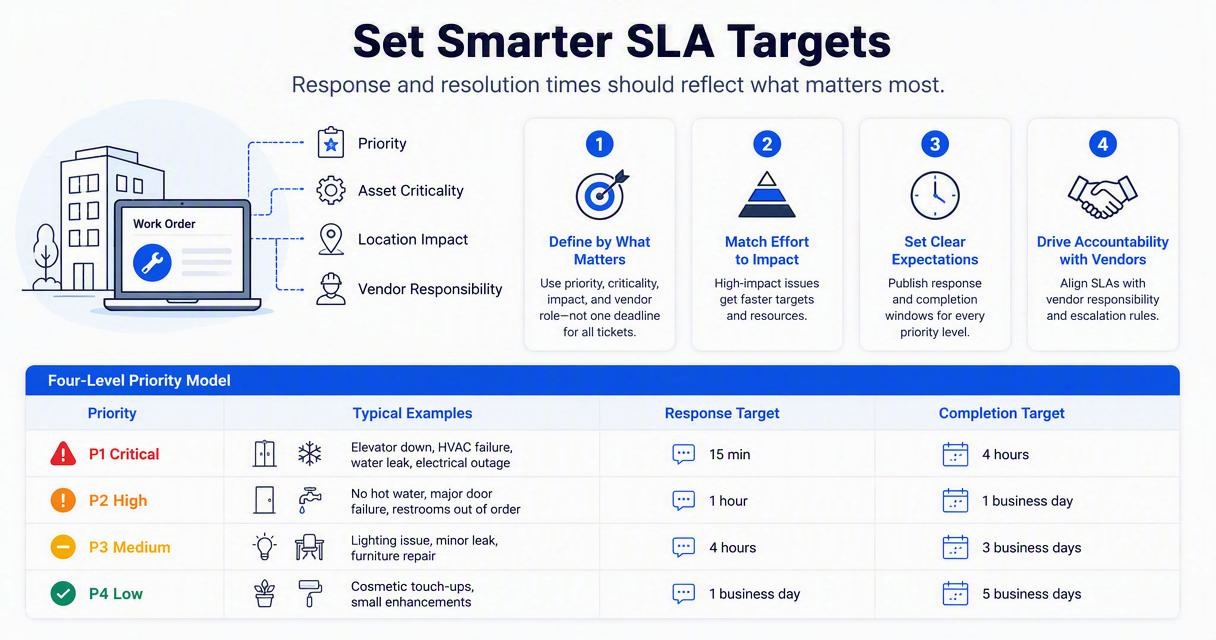
Sample SLA target matrix for facility work orders
| Priority | Typical examples | Response target | Completion target | Escalation trigger |
|---|---|---|---|---|
|
P1 emergency |
Flood, power loss, life-safety issue, major access failure |
15 minutes |
4 hours or continuous work |
Notify facilities director immediately |
|
P2 urgent |
HVAC outage in occupied area, refrigeration risk, blocked restroom |
1 hour |
24 hours |
Escalate after 2 missed updates |
|
P3 standard |
Lighting, minor plumbing, door hardware, comfort complaint |
1 business day |
3 to 5 business days |
Escalate at 80% of due window |
|
P4 planned |
Paint, signage, small upgrades, noncritical repairs |
3 business days |
Scheduled date |
Review during weekly planning |
Asset criticality keeps the matrix honest. A leaking sink in a back office may be P3, while the same leak above electrical equipment may become P1. Location also matters: a customer-facing retail floor, operating room, data room, or campus housing area carries a different service expectation than a storage closet.
Vendor responsibility should be written into the target, not added later. A vendor-owned SLA needs dispatch rules, proof-of-arrival expectations, quote approval limits, and closeout documentation. For broader software selection, multi-site teams can compare options in this guide to the best work order systems for multi-site facilities in 2026.
A basic scoring rule helps prevent arguments:
-
Priority: How severe is the operational risk?
-
Criticality: How important is the asset to uptime, safety, revenue, or compliance?
-
Location: How visible or business-critical is the affected area?
-
Responsibility: Is the owner internal labor, a landlord, an OEM, or a contracted vendor?
-
Dependency: Is parts availability, access approval, or shutdown coordination required?
How should escalation rules and ownership work?
Escalation rules should move overdue or high-risk work orders to the next accountable person before the SLA is missed, not after the facility user complains. Good escalation design combines time-based alerts, status-based triggers, and clear owner roles.
"Plans are worthless, but planning is everything.", Dwight D. Eisenhower, National Archives
A simple escalation workflow
-
Create the ticket with required fields: asset, location, priority, requester, photos, and vendor category.
-
Assign the first owner: internal technician, dispatcher, property manager, vendor, or landlord contact.
-
Start the SLA clock: response and completion timers begin based on priority and business hours.
-
Send warning alerts: notify the owner at 50%, 80%, and 100% of the SLA window.
-
Escalate automatically: route missed updates or overdue work to a supervisor or vendor manager.
-
Require closure evidence: capture notes, labor, parts, photos, invoice status, and root cause.
-
Review exceptions: separate true delays from poor coordination, missing parts, or unclear approvals.
The ownership model should match the operating model. A centralized facilities desk may own triage and dispatch, while local managers confirm access and completion. A decentralized campus may allow building teams to assign work directly, with central oversight for compliance and reporting. The tradeoffs are covered further in this guide to centralized vs. decentralized work orders for campuses.
Fast work order flow also depends on intake quality. Duplicate requests, missing asset names, vague photos, and unclear vendor categories slow the clock before any wrench turns. Teams trying to cut handoff time can use this practical guide on how to simplify facility work orders fast.
Which metrics prove SLA performance?
The best SLA reports show timeliness, backlog risk, repeat issues, and vendor accountability in one view. Facility leaders should track both compliance rates and the reasons work missed target, because overdue totals alone do not explain what to fix.
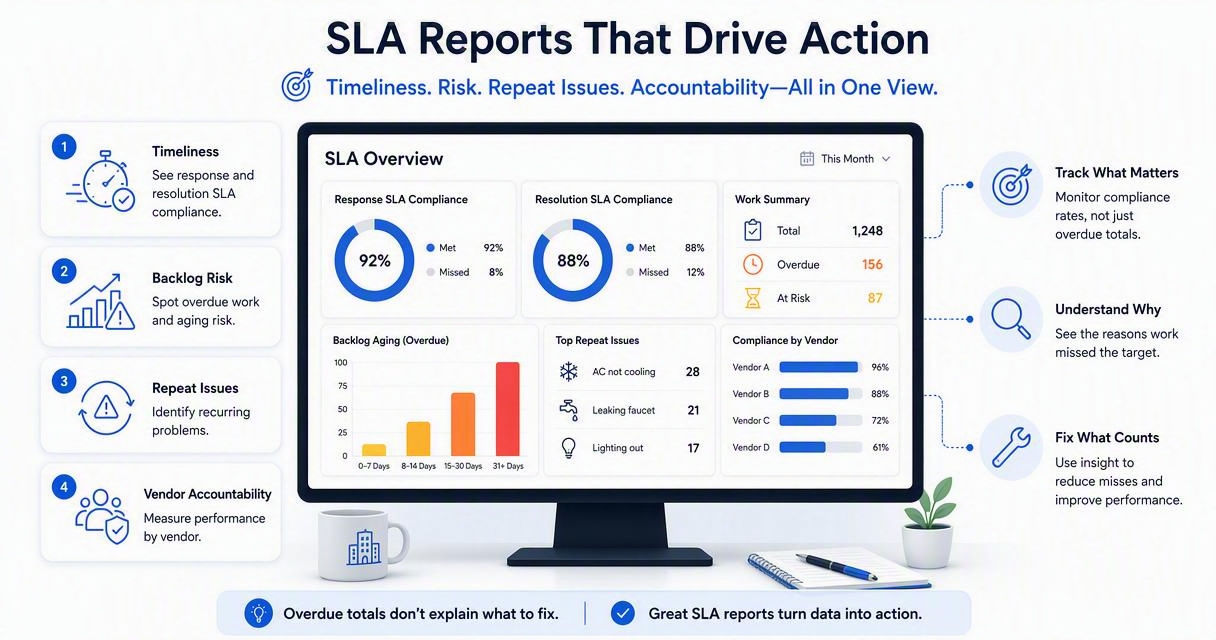
SLA dashboard metrics worth reviewing weekly
|
Metric |
What it shows |
Why it matters |
|---|---|---|
|
Response SLA compliance |
Percent acknowledged on time |
Tests dispatch speed and owner awareness |
|
Completion SLA compliance |
Percent closed on time |
Shows actual service reliability |
|
Overdue backlog by priority |
Open work past target |
Highlights operational risk |
|
Average age of open work |
Time since ticket creation |
Finds stuck work before it becomes chronic |
|
Repeat work orders by asset |
Recurring failures |
Signals replacement, PM, or vendor quality issues |
|
Vendor on-time rate |
SLA compliance by supplier |
Supports contract reviews and scorecards |
|
Deferral reasons |
Parts, access, quote, shutdown, scope |
Separates controllable delays from constraints |
Dashboards should include trends by asset type, building, region, and vendor. A portfolio view helps executives see whether one site has a maintenance issue or the whole program has a process issue. For facility leaders focused on visibility, related reporting concepts appear in this article on work order transparency for campus facilities in 2026.
Useful dashboard walkthrough
SLA reporting also shows when a basic ticketing tool has stopped scaling. Warning signs include manual exports, no vendor scorecards, weak mobile updates, and no asset-level history. Those symptoms are covered in when basic work order software stops scaling.
How Leansite handles this
The Leansite platform is built for teams that need work order intake, technician tracking, vendor coordination, and portfolio visibility in one place. With Leansite, facility teams can standardize service levels across locations while still routing work by site, asset, trade, and owner.
A useful SLA system should make the next action obvious: accept, assign, escalate, defer, or close. For teams comparing platforms, this roundup of top work order platforms for multi-site facilities can help frame the feature set needed before a buying decision.
FAQ: Work order SLA tracking
What is a good SLA for maintenance work orders?
A good maintenance SLA matches the risk of the work. Emergency items often need response in minutes and continuous action until stabilized. Standard repairs may allow several business days. Planned improvements can follow scheduled dates. The target should reflect safety, uptime, customer impact, asset criticality, and vendor availability.
Who owns SLA compliance in facility management?
SLA compliance usually belongs to the facilities leader, but daily ownership is shared by dispatchers, technicians, vendors, and site managers. The best model assigns one accountable owner per work order and one escalation owner per priority level. Vendor-owned work should still remain visible to the facility team.
Should SLA timers pause for parts or access delays?
SLA timers can pause for approved reasons such as parts lead time, site access limits, shutdown windows, or quote approval. The pause reason should be required, time-stamped, and reportable. Without that discipline, paused tickets can hide poor follow-up and make service performance look better than reality.
How often should facility teams review SLA reports?
High-volume teams should review priority exceptions daily and full SLA trends weekly. Monthly reviews work better for vendor scorecards, asset replacement discussions, budget planning, and executive reporting. The goal is not just compliance; the goal is fewer repeat failures and fewer urgent surprises.
What changes are likely in 2027?
By 2027, SLA tracking will likely depend more on sensor alerts, mobile proof of work, and AI-assisted triage. Research on AI monitoring in other fields, such as the 2023 review of remote monitoring challenges by Shaik, Tao, and Higgins in Wiley Interdisciplinary Reviews, shows why data quality, alert design, and human oversight still matter.
Conclusion
Work order SLA tracking facility management works when service promises become daily operating rules: clear priorities, realistic deadlines, accountable owners, timely escalations, and honest reporting. The next step is to audit the last 90 days of work orders, group misses by cause, and rebuild the SLA matrix around the assets and locations that carry the highest risk. For teams ready to replace spreadsheet follow-up with structured maintenance workflows, Leansite offers a practical path to cleaner dispatching, stronger vendor visibility, and better portfolio reporting. Visit getleansite.com to see how SLA tracking can fit an active facilities operation.