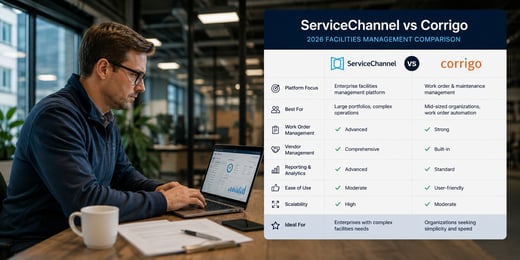
TL;DR
Vendor dispatch software helps facility teams turn maintenance requests into assigned, tracked, and documented vendor work. The best fit in 2026 connects work orders, SLA timers, contractor communication, asset history, mobile updates, and scorecards in one operating view.
Missed handoffs create more facility downtime than most teams admit. Vendor dispatch software for facility maintenance is a work coordination system that receives service requests, assigns approved vendors, tracks job status, captures proof of work, and keeps facility managers informed from intake to closeout. The idea builds on computer-aided dispatch, which Wikipedia defines as dispatching field service technicians and other mobile workers with computer assistance via computer-aided dispatch. For multi-site operators, Leansite brings that coordination layer into facility maintenance, where uptime, cost control, and contractor accountability matter every day.
Table of Contents
What is vendor dispatch software for facility maintenance?
Vendor dispatch software for facility maintenance is software that routes maintenance jobs to internal teams or outside vendors, then tracks acceptance, scheduling, completion, cost, and compliance in one system.
Vendor dispatch software: a digital workflow tool that matches a maintenance request with the right service provider, location, asset, priority, and approval path.
A dispatcher, according to Wikipedia, is a communications worker who receives and transmits information to coordinate service personnel and vehicles via dispatcher. In facilities, that role often sits inside operations, property management, or a centralized maintenance desk.
Key insight: Dispatch is not just assignment. In facility maintenance, dispatch connects work orders, vendors, SLAs, invoices, photos, notes, and asset records so every party sees the same job status.
Older workflows depend on email, spreadsheets, phone calls, and portal logins. That creates gaps when a roof leak, HVAC fault, plumbing issue, or electrical repair needs fast action across several buildings. Modern dispatch tools replace that scattered communication with a controlled workflow.
Facility teams comparing broader systems can use the complete guide to multi-location facilities management software as a useful companion when dispatch is only one part of the operating model.
How should the vendor dispatch workflow run?
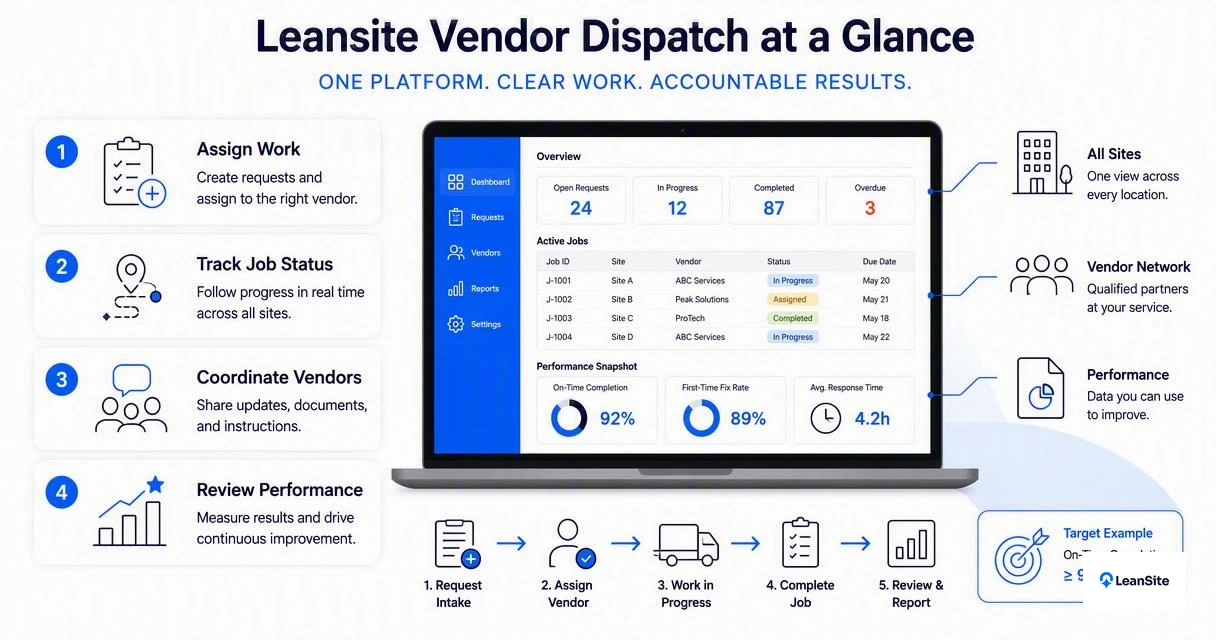
A strong dispatch workflow should move from request intake to vendor assignment, acceptance, scheduling, field updates, verification, and cost review without forcing managers to chase status manually.
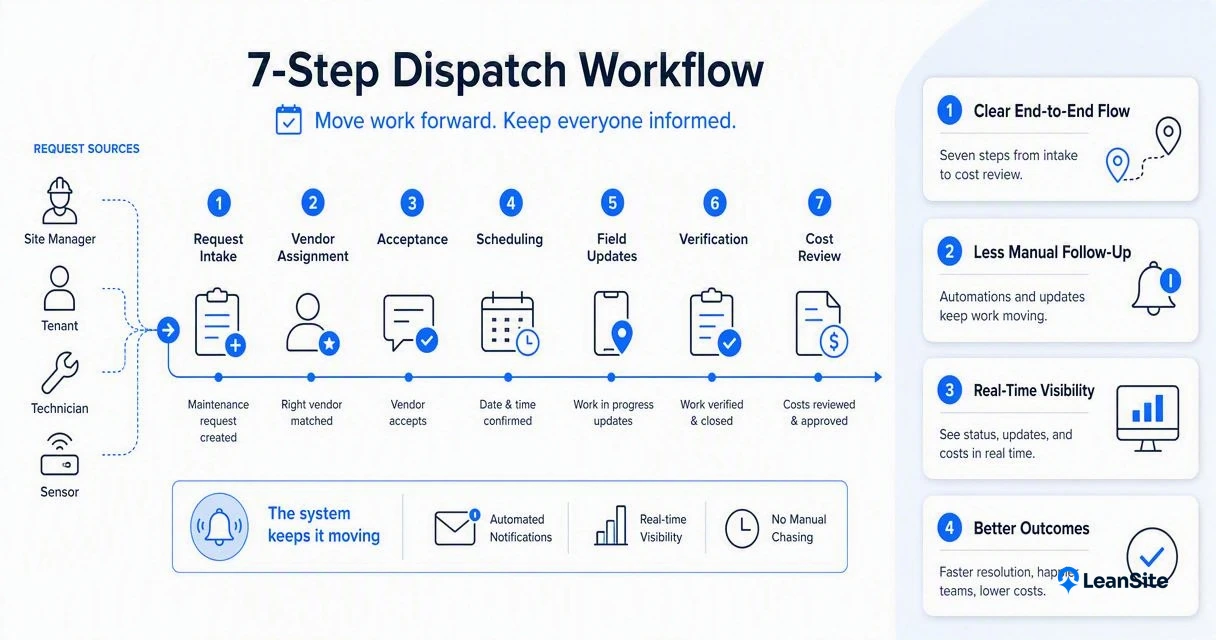
A practical workflow has seven steps:
- Request intake: A site manager, tenant, technician, or sensor creates a maintenance request.
- Triage: The system tags asset, location, issue type, urgency, and SLA.
- Vendor matching: Approved vendors are filtered by trade, coverage area, insurance, rates, and availability.
- Dispatch: The selected vendor receives the job with scope, photos, access notes, and due time.
- Execution: Field teams update arrival, diagnosis, parts, labor, and completion notes.
- Verification: Facility staff review photos, timestamps, signatures, and exception notes.
- Closeout: Costs, invoice data, asset history, and vendor performance feed reporting.
That sequence matters because maintenance requests rarely fail at intake. They fail during unclear ownership, delayed acceptance, poor site access details, or missing closeout records.
Research on connected operations supports this shift. The Internet of Things Strategic Research Roadmap by Ovidiu Vermesan, Peter Friess, and Patrick Guillemin describes the role of connected devices and data exchange in operational systems via River Publishers. For facilities, IoT inputs can trigger work faster, but dispatch still decides who acts and how the job is tracked.
Multi-site teams that want to connect dispatch with earlier failure detection can read more on vendor dispatch and predictive maintenance automation for multi-site teams.
Which dispatch features matter most in 2026?
The most useful dispatch features in 2026 are vendor qualification, mobile job updates, SLA tracking, asset context, cost controls, and performance reporting.
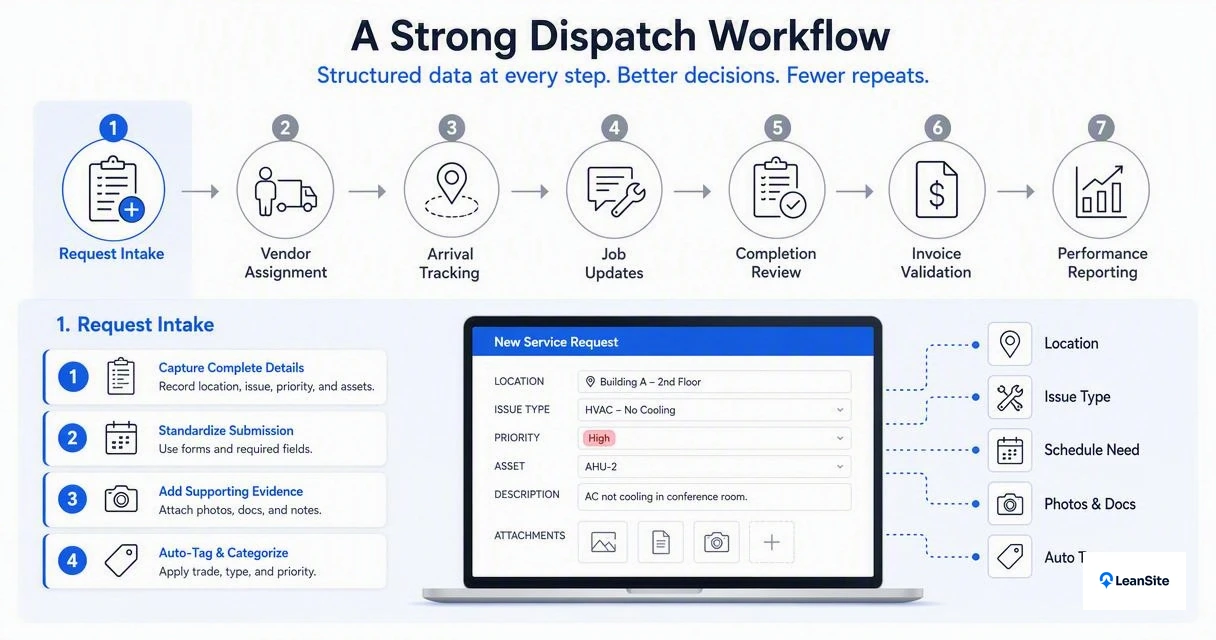
Many facility tools can create a work order. Fewer manage the messy middle, where a vendor accepts the job, reaches the site, requests approval, completes the repair, and submits documentation. That middle is where cost leakage and downtime grow.
Feature checklist for facility teams
| Feature | Why it matters | Best-fit use case |
|---|---|---|
| Approved vendor directory | Keeps trade coverage, insurance, and rates organized | Retail, healthcare, offices, restaurants |
| Rules-based assignment | Reduces manual routing for repeat work | Multi-location portfolios |
| SLA timers | Shows overdue acceptance, arrival, and completion | Critical assets and tenant-facing issues |
| Mobile status updates | Captures field notes, photos, timestamps, and signatures | HVAC, plumbing, electrical, janitorial |
| Asset history | Links each repair to equipment records | Preventive maintenance planning |
| Quote and approval flow | Controls spend before work expands | Capital-sensitive property teams |
| Vendor scorecards | Compares response time, quality, and cost | Contractor management |
| Offline access | Helps field teams update jobs with poor signal | Campuses, basements, industrial sites |
A good dispatch product should also support exception handling. Examples include rejected jobs, after-hours approvals, unavailable parts, site access problems, warranty questions, and repeat failures on the same asset.
AI is also becoming normal in facilities software. The best use is not magic automation. It is faster triage, clearer job summaries, vendor recommendations, duplicate request detection, and easier reporting. Related planning detail is covered in AI facility management software.
Helpful buying-video overview
Video reviews can help frame the broader property software market, but facility maintenance dispatch needs deeper operational checks than basic property management tools usually show.
How Leansite handles dispatch and vendor visibility
Leansite handles dispatch by connecting maintenance requests, vendors, locations, work orders, and performance visibility inside one facility operations workflow.
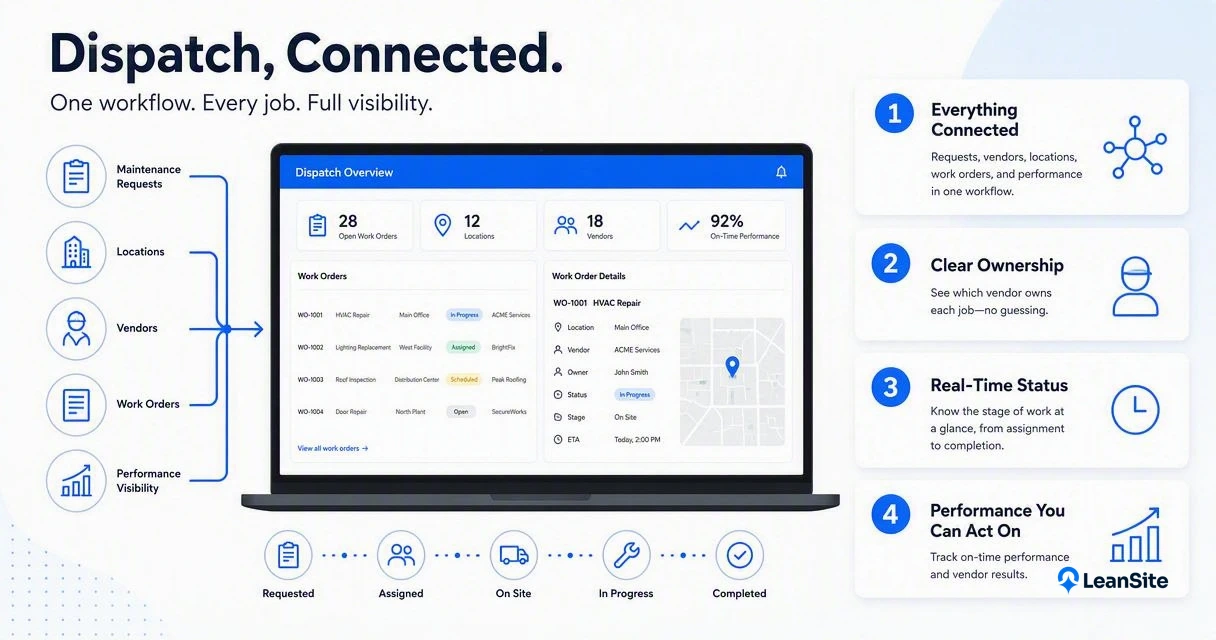
The Leansite platform is built for teams that need more than a ticket queue. It helps maintenance leaders see which vendor owns a job, what stage the work is in, and how performance trends across locations. That matters when a facilities director is managing dozens or hundreds of properties, not one building.
A typical use case is a multi-site HVAC issue. A store submits a request with photos. The system routes the job to an approved contractor for that region. The vendor updates status from a mobile device. The facility team reviews completion notes, compares cost against expectations, and keeps asset history available for future decisions.
Key insight: The strongest dispatch systems do not stop at sending work out. They make vendor performance measurable by location, trade, asset type, response time, and closeout quality.
Leansite also fits teams exploring smarter work-order models, especially where AI can help summarize requests or surface recurring issues. The overview of Vera, the AI assistant built into Leansite AI's facility management software, explains that direction in more detail at meet Vera.
Facility leaders comparing dispatch tools should focus on actual workflow depth rather than long feature lists. A system should answer practical questions fast:
- Which vendor has the job right now?
- Has the vendor accepted the assignment?
- Is the SLA at risk?
- What did the technician find onsite?
- Was the repair verified before payment?
- Does the same asset keep failing?
More implementation examples and product context are available at getleansite.com.
How should facility teams choose dispatch software?
Facility teams should choose dispatch software by mapping current maintenance handoffs, then testing whether each platform reduces response delays, improves vendor accountability, and gives leaders cleaner cost visibility.
A smart buying process stays grounded in real work. Demo scripts should include urgent repairs, scheduled preventive work, after-hours requests, rejected dispatches, quote approvals, partial completions, and invoice review. Polished dashboards mean less if the field workflow breaks.
Vendor evaluation matrix
| Question | Strong answer | Weak answer |
|---|---|---|
| Can vendors update jobs from mobile? | Yes, with photos, notes, timestamps, and status | Email updates still required |
| Can dispatch rules vary by location? | Yes, by trade, geography, SLA, and vendor tier | One shared queue for all sites |
| Can costs be reviewed before closeout? | Yes, with quote and approval controls | Invoice review happens later |
| Can reports compare vendors? | Yes, by response, completion, cost, and quality | Only basic work-order counts |
| Can the tool scale across sites? | Yes, with portfolio-level visibility | Built mainly for one facility |
Common mistakes include buying only for ticket creation, ignoring vendor onboarding, skipping data cleanup, and failing to define service levels before launch. Another issue is choosing a tool that works for corporate users but frustrates contractors in the field.
Teams reviewing broad maintenance categories may find the comparison in best multi-site maintenance software in 2026 helpful. Campus operators with large internal crews can also compare work-order needs in best work order software for campus facilities in 2026.
Looking ahead, 2027 dispatch tools will likely make heavier use of IoT signals, optimization models, and AI triage. The 2021 IEEE Access review of NSGA-II covers multi-objective combinatorial optimization problems via IEEE Access, a research area related to balancing constraints such as time, cost, route, and capacity. The 2022 study on Industry 4.0 adoption also connects modern digital technologies with sustainability improvements via Sustainable Operations and Computers.
FAQ
What problems does vendor dispatch software solve?
Vendor dispatch software reduces missed handoffs, unclear ownership, slow vendor response, weak documentation, and scattered communication. It gives facility teams one record for request intake, assignment, status updates, approvals, closeout, and vendor performance.
Is dispatch software the same as CMMS software?
Dispatch software and CMMS software overlap, but they are not always the same. A CMMS focuses on assets, work orders, preventive maintenance, and maintenance history. Dispatch software focuses more tightly on assigning work to people or vendors, tracking status, and coordinating service delivery.
Who needs vendor dispatch tools most?
Multi-location operators, property managers, retail facilities teams, restaurants, healthcare sites, campuses, and enterprise maintenance teams benefit most. The need grows when outside vendors handle a large share of repairs or when leaders need better visibility across many sites.
What should be prepared before rollout?
Facility teams should prepare vendor lists, trade categories, location data, asset records, priority levels, SLA rules, approval thresholds, and reporting goals before rollout. Clean setup data makes dispatch automation more reliable and helps vendors understand expectations from the start.
How fast can dispatch software show value?
Value can appear quickly when the first workflow replaces phone calls and email chains with tracked assignment and status updates. Larger gains usually come after enough completed jobs reveal vendor response patterns, repeat asset failures, and avoidable cost trends.
Conclusion
Vendor dispatch software for facility maintenance works best when it becomes the operating layer between requests, vendors, assets, and cost decisions. The next step is a focused workflow review: list the top five recurring repair types, map the current handoffs, define the must-have dispatch rules, then compare systems against real jobs instead of generic demos. For teams ready to modernize that process with Leansite, visit getleansite.com and evaluate how dispatch, work orders, vendor scorecards, and AI-assisted visibility fit the current maintenance operation.