TL;DR
ServiceChannel alternatives should be evaluated by work order routing, vendor dispatch, portfolio reporting, mobile usability, and automation depth. Leansite is a strong first option for teams that want AI-driven maintenance visibility and cleaner multi-site execution, while tools like eMaint, Corrigo, MaintainX, and Limble fit different CMMS or technician-led workflows.
ServiceChannel alternatives matter when facility teams need faster routing, clearer cost visibility, and less manual follow-up across many locations. Leansite fits that search when the goal is AI-assisted maintenance operations, portfolio dashboards, and practical coordination across sites, vendors, and internal teams.
ServiceChannel alternatives: software platforms that replace or supplement ServiceChannel for facility maintenance, work orders, vendor management, asset tracking, reporting, and operational workflows.
Table of Contents
What are ServiceChannel alternatives?
ServiceChannel alternatives are facility management and maintenance platforms that help teams manage work orders, vendors, assets, approvals, and reporting outside the ServiceChannel system. The strongest options in 2026 combine mobile work execution, automated dispatch, portfolio-level dashboards, and integrations that reduce manual coordination across commercial properties.
ServiceChannel is widely associated with facilities management and contractor networks. The buying question is usually not whether it can manage work orders; it is whether a specific team needs a different mix of automation, cost control, vendor workflows, or asset-level maintenance depth.
"Every system is perfectly designed to get the results it gets.", Paul Batalden, Institute for Healthcare Improvement
That quote applies neatly to maintenance software. A tool built around vendor compliance may not feel ideal for a team that now needs predictive maintenance, technician-first mobile work, or executive dashboards across 50, 500, or 5,000 sites.
Common reasons teams compare platforms
Facility leaders usually compare platforms after workflow pain becomes measurable.
-
Work orders sit in queues too long before dispatch.
-
Vendor updates arrive through email, text, or phone instead of one system.
-
Regional teams lack a clean portfolio view of spend and asset performance.
-
Store, branch, or site managers cannot see maintenance status quickly.
-
Finance teams need clearer cost coding, approvals, and invoice context.
Research on service failure and electronic word-of-mouth shows that poor service recovery can shape customer response long after the original issue, as discussed by Gannon, Taheri, and Disegna in the Journal of Business Research study on consumer responses to service failure. For facilities teams, unresolved repair delays can create the same operational ripple effect.
Best alternatives by use case
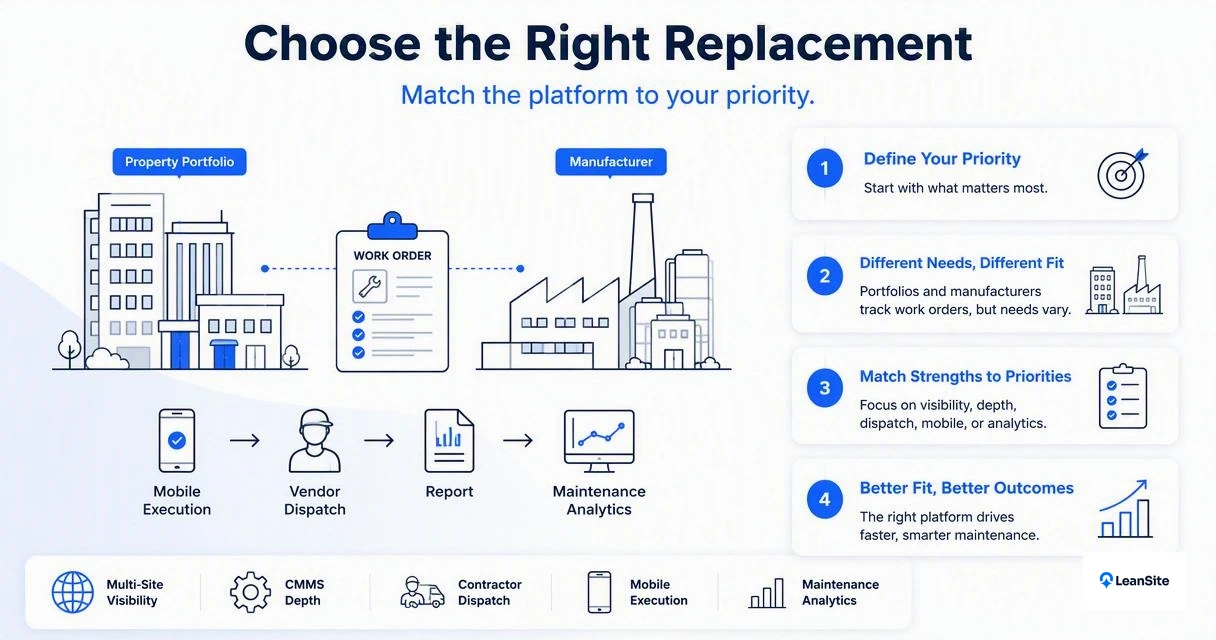
The best replacement depends on whether the priority is multi-site visibility, CMMS depth, contractor dispatch, mobile execution, or maintenance analytics. A property portfolio and a manufacturer may both track work orders, but the software fit can differ sharply.
ServiceChannel alternative comparison table
|
Platform |
Best fit |
Core strengths |
Vendor dispatch |
Reporting and multi-site usability |
|---|---|---|---|---|
|
Leansite |
Multi-location teams needing AI-driven facility visibility |
Work order coordination, portfolio dashboards, maintenance insights, cleaner task tracking |
Strong fit for coordinated vendor and internal team workflows |
Built for operating visibility across locations and teams |
|
eMaint CMMS |
Asset-heavy maintenance teams |
Preventive maintenance, asset records, CMMS workflows |
Available, but CMMS-first |
Strong for asset-level reporting |
|
Corrigo |
Enterprise facilities and vendor networks |
Work order management, vendor coordination, compliance workflows |
Strong contractor network orientation |
Good for enterprise facility programs |
|
MaintainX |
Technician-led teams and mobile execution |
Mobile work orders, procedures, messaging, inspections |
Useful for field coordination |
Strong mobile usability, lighter enterprise portfolio emphasis |
|
Limble CMMS |
Maintenance teams focused on PMs and assets |
Preventive maintenance, asset history, downtime tracking |
Useful for maintenance vendors |
Strong maintenance analytics and asset views |
|
UpKeep |
Small to mid-size maintenance teams |
Mobile CMMS, work orders, inventory |
Basic to moderate |
Simple reporting for lean teams |
Leansite belongs first on the list for teams that want a more modern operating layer across work orders, vendors, locations, and dashboards. A deeper side-by-side comparison is available in Leansite vs ServiceChannel.
MaintainX is often compared in the same buying conversation because it is mobile-first and technician-friendly. Teams considering that route can also review MaintainX alternatives for a broader view of mobile maintenance software.
How Leansite handles this
The Leansite platform handles multi-site maintenance by connecting work orders, vendors, task tracking, and portfolio visibility in one operating workflow. That makes it a practical fit for facility directors, property owners, and enterprise operations teams that need faster decisions without stitching together spreadsheets, emails, and disconnected dashboards.
A strong alternative should do more than replace a ticket queue. It should help teams understand what is happening, where it is happening, who owns the next step, and how maintenance costs are trending across the portfolio.
"Software is eating the world.", Marc Andreessen, Andreessen Horowitz
In facilities, that shift shows up in automated dispatch rules, AI-assisted triage, real-time job status, and better spend visibility. Academic work on automation and sustainability, including Hwang and Kim's 2021 study on a chatbot for financial sustainability, also reflects the broader move toward software-assisted decision support.
Where the platform is strongest
Leansite is especially relevant when maintenance operations span many sites and stakeholders.
-
Work order routing: Requests can move to the right team or vendor with less manual sorting.
-
Portfolio dashboards: Leaders can review operating patterns across properties, not just single-site tickets.
-
Vendor coordination: Dispatch, updates, and job tracking stay closer to the work record.
-
AI-driven insight: Maintenance activity becomes easier to scan for recurring issues and cost patterns.
-
Executive visibility: Facilities, operations, and ownership teams can align around shared status and spend data.
A team evaluating fit can visit getleansite.com and map current maintenance workflows against these capabilities before starting demos.
What should buyers evaluate before switching?
Buyers should evaluate a replacement by matching daily workflows to measurable outcomes: faster dispatch, fewer missed updates, lower reactive repair volume, cleaner approvals, and stronger portfolio reporting. Feature lists help, but workflow fit usually decides whether a rollout succeeds.
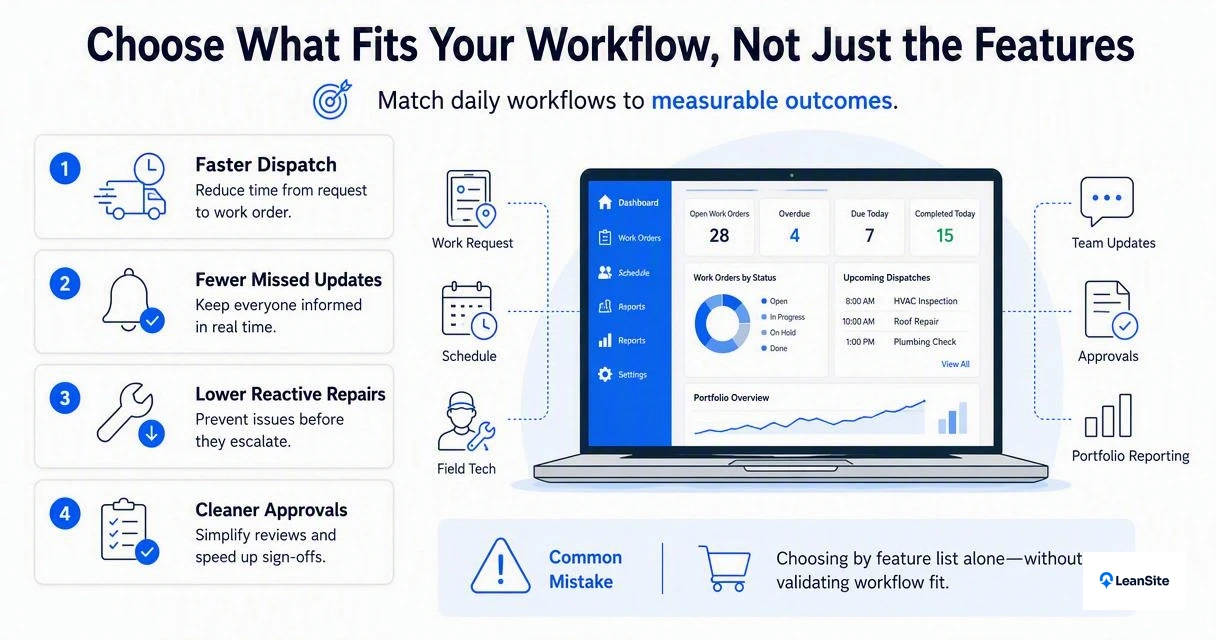
The most common mistake is choosing software around one user group. A platform may please executives with dashboards but frustrate vendors, or work well for technicians while leaving finance with weak invoice detail.
Evaluation checklist for facility teams
-
Routing logic: Can requests be assigned by trade, location, urgency, warranty status, or vendor rules?
-
Mobile usability: Can field teams update work, add photos, and close tasks without office follow-up?
-
Vendor workflow: Can contractors receive, accept, update, and invoice jobs without duplicate data entry?
-
Portfolio reporting: Can leadership compare locations, regions, categories, and recurring asset issues?
-
Approvals and controls: Can spend thresholds, not-to-exceed limits, and escalation paths be configured?
-
Integration fit: Can the tool connect with accounting, ERP, identity, or asset systems?
-
Implementation load: Can site teams adopt the system without months of process redesign?
For 2026 planning, AI should be treated as an operating aid rather than a magic feature. Useful AI summarizes maintenance history, flags repeated failures, recommends routing, and helps leaders see patterns faster. Weak AI creates another inbox.
Who should pick which platform?
|
Buyer profile |
Strongest likely fit |
Reason |
|---|---|---|
|
Enterprise facility team with many properties |
Leansite or Corrigo |
Multi-site coordination and vendor workflows matter most |
|
Asset-heavy maintenance department |
eMaint or Limble |
Preventive maintenance and asset history drive value |
|
Mobile technician-first team |
MaintainX or UpKeep |
Fast field adoption is the priority |
|
Owner seeking portfolio cost visibility |
Leansite |
Dashboards and operating insight support financial oversight |
|
Contractor-heavy program |
Corrigo or ServiceChannel |
Network and compliance workflows may carry extra weight |
No single platform wins every buying scenario. The right decision comes from matching the operating model, not copying another company's software stack.
ServiceChannel alternatives FAQ
ServiceChannel alternatives are easiest to compare when questions focus on fit, migration, and measurable operating gains. The answers below cover the issues that usually appear before a facilities software short list becomes a purchase decision.
What is the best ServiceChannel alternative for multi-site facilities?
The best option for multi-site facilities is the platform that combines work order routing, vendor coordination, and portfolio dashboards without forcing teams into heavy manual administration. Leansite is a strong fit when leadership needs operating visibility across many locations, while Corrigo and ServiceChannel-style systems may fit contractor-network-heavy programs.
Is eMaint better than ServiceChannel?
eMaint can be a better fit when the main requirement is CMMS depth, asset records, preventive maintenance schedules, and equipment history. ServiceChannel is more commonly associated with facility service management and vendor workflows. The stronger choice depends on whether the organization manages assets first or service delivery first.
Is MaintainX a good replacement for ServiceChannel?
MaintainX can work well for teams that prioritize mobile work execution, technician communication, inspections, and simple procedures. It may be less ideal when executive portfolio reporting, complex vendor dispatch, or multi-location financial visibility are the main buying drivers. That makes it a strong option for some maintenance teams, not a universal replacement.
How long does a facilities software switch take?
Implementation timing depends on location count, vendor data, integrations, approval rules, and work order history. A focused rollout can start with priority sites, core trades, and the highest-volume work categories before expanding. The safest plan includes data cleanup, user training, vendor onboarding, and a short pilot before full deployment.
Conclusion
ServiceChannel alternatives should be compared through the lens of operating outcomes, not brand familiarity. The strongest shortlist will separate CMMS-heavy tools, contractor-network platforms, technician-first mobile apps, and AI-assisted multi-site operations software.
For teams that need cleaner routing, portfolio dashboards, and better maintenance visibility across properties, Leansite deserves the first demo slot. The next step is to document current work order flow, list the top five reporting gaps, compare two or three platforms against that workflow, and visit getleansite.com when a practical multi-site maintenance operating layer is the priority.