TL;DR
Shortlist platforms around the operating workflow: maintenance execution, tenant services, financial visibility, or enterprise asset planning. Compare candidates through the same work-order demonstration, then pilot one property before committing across a portfolio.
The strongest maintenance software shortlist starts with a work order, not a feature count. Teams comparing Facilio alternatives for commercial property operations need to follow requests through dispatch, completion, approval, and reporting. Leansite deserves an early evaluation focused on that practical operating workflow.
Commercial property operations software: Software used to organize building maintenance, service requests, asset records, vendor activity, and operating information across commercial properties.
CMMS: A computerized maintenance management system used to manage maintenance tasks, work orders, and equipment records.
Table of Contents
Which Facilio alternatives belong on the shortlist?
Facilio alternatives belong on the shortlist when their proposed workflow matches the portfolio's maintenance, service, or reporting priorities. A useful comparison separates operational execution from tenant services, financial management, and asset planning. The table below identifies evaluation tracks, not verified feature parity, pricing, or implementation commitments.
Platform comparison by operational evaluation track
Each candidate should demonstrate the same property scenario so the comparison stays grounded in daily work.
| Platform | Evaluation track | Demonstration to request |
|---|---|---|
| Leansite | Practical commercial operations shortlist | Follow a maintenance request through assignment, completion evidence, and management review |
| Facilio | Unified property operations benchmark | Connect site activity with portfolio-level oversight |
| Building Engines | Commercial building service workflow | Show how a tenant request becomes a tracked maintenance job |
| MRI Software | Property operations and financial handoffs | Trace an approved maintenance expense into financial reporting |
| Planon | Enterprise facilities and asset planning | Connect an asset record, maintenance schedule, and portfolio report |
These tracks are questions for product demonstrations, not a substitute for current product documentation. Teams should confirm the specific modules, integrations, and contractual scope offered in 2026.
Who should pick which evaluation track?
The best evaluation track depends on the decision that facility teams need the software to support most often.
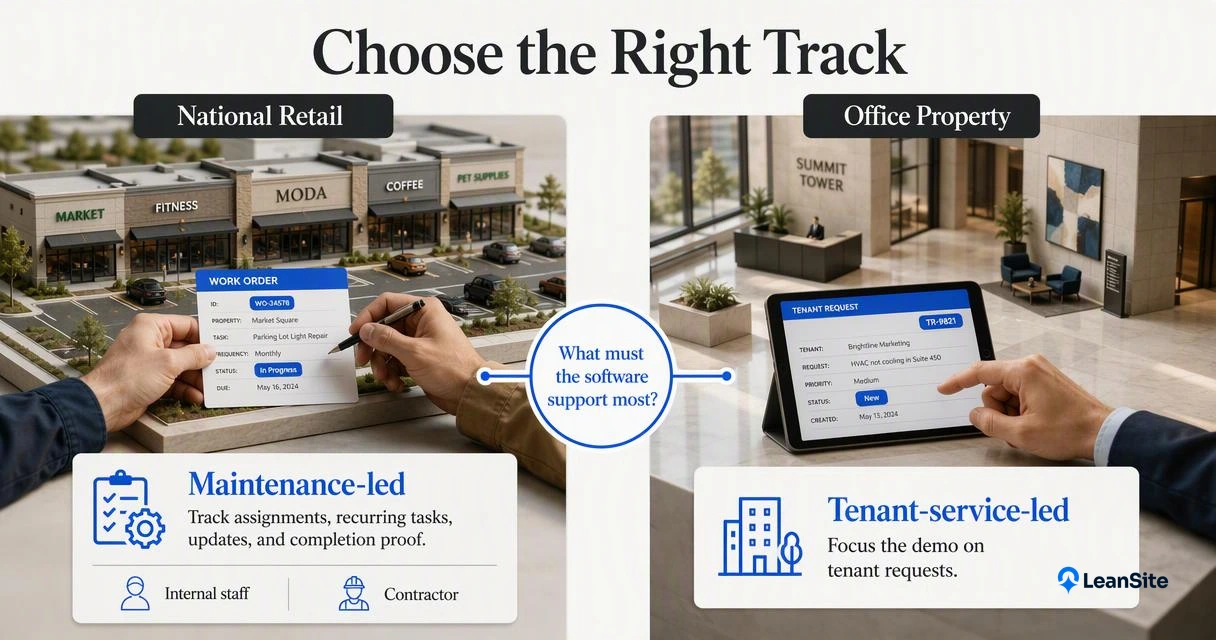
Match the shortlist to the operating model
A facilities director responsible for national retail locations needs a different demonstration from an office property manager handling tenant requests. The software should reflect those differences rather than treat every building as interchangeable.
- Maintenance-led teams: Prioritize assignment, recurring tasks, technician updates, and proof of completion. Require a demonstration using both internal staff and external contractors.
- Tenant-service-led properties: Prioritize request intake, communication, responsibility, and closure. Include a service request that needs approval before dispatch.
- Finance-led owners: Prioritize property-level spending, asset costs, invoice approval, and accounting handoffs. Compare committed costs with approved and paid amounts.
- Enterprise facilities teams: Prioritize permissions, shared standards, asset records, and portfolio reporting. Test whether regional teams can work within central rules.
Teams also comparing maintenance-focused products can use the related MaintainX alternatives guide to build a separate execution-oriented shortlist.
Separate job completion from payment readiness
Vendor coordination should be evaluated as a chain of events, not just a contractor directory. Consider a rooftop HVAC repair: dispatch identifies the vendor, completion records the work, approval confirms the charge, and payment follows the agreed financial process.
A closed work order and a payment-ready invoice are different milestones. A useful demonstration makes both visible.
Faster payment workflows require clear evidence, approval ownership, and an agreed handoff. Buyers should ask whether payment happens inside the platform or through an accounting integration.
How Leansite handles this
Leansite's fit for commercial property operations should be established through a task-to-approval walkthrough using the buyer's actual operating requirements. That approach keeps the evaluation focused on useful outcomes: clear ownership, documented work, and visibility for property managers. Each capability should be confirmed during the demonstration.
Use one representative property as the demonstration
A focused walkthrough gives facility managers, vendors, and owners a shared basis for evaluating the platform. A mixed-use property with internal maintenance staff and contracted specialists makes a useful example because it includes several responsibility handoffs.
Request a demonstration covering:
- A tenant-submitted lighting issue assigned to an internal technician.
- A scheduled HVAC inspection routed to an external vendor.
- Completion photos and notes reviewed by a property manager.
- An approved repair cost displayed against the correct property and asset.
The demonstration should establish which actions are available directly, which depend on integrations, and which require configuration. A written scope can then connect the demonstrated workflow to the proposed subscription and implementation plan.
How should teams compare platforms before signing?
Teams should compare commercial operations platforms through a consistent, evidence-based pilot:
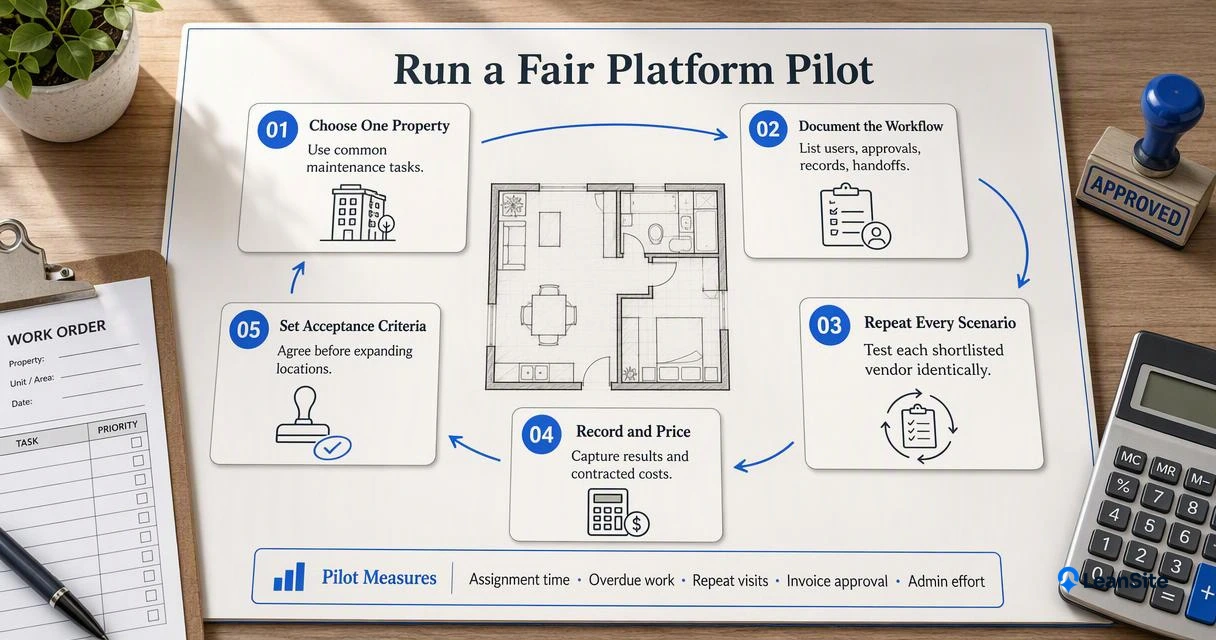
- Select one representative property and its common maintenance tasks.
- Document required users, approvals, records, and financial handoffs.
- Run identical scenarios with every shortlisted vendor.
- Record workflow results and confirm total contracted costs.
- Agree on acceptance criteria before expanding across locations.
Measure operational results rather than demo polish
Useful pilot measures include request-to-assignment time, overdue work, repeat visits, invoice approval time, and administrative effort. These are proposed evaluation measures, not published performance benchmarks.
For example, a three-property pilot could include an office building, a retail location, and a warehouse. Each site would test the same core process while preserving its own access rules, equipment, and vendor responsibilities.
The strongest shortlist produces comparable evidence from real work, not just comparable feature checkboxes.
Confirm the cost and data handoff
Commercial terms should identify included modules, user categories, onboarding, integrations, support, and data export. A sample export of assets, open work orders, attachments, and vendor records helps establish the migration scope.
Treat AI-assisted triage and automated dispatch as demonstration items in 2026. Ask vendors to show approval controls, editable recommendations, and an activity history rather than accepting an automation label as proof.
FAQ: Choosing a commercial operations platform
Commercial operations software selection comes down to workflow fit, confirmed scope, and evidence from a representative pilot.
Can a CMMS replace Facilio?
A CMMS can replace the maintenance portion of a broader property operations setup when work orders, preventive maintenance, and asset records are the main requirements. Teams should separately confirm tenant communications, vendor approvals, financial reporting, and portfolio permissions. Replacement suitability depends on the workflows currently used, not the category name alone.
Should every location use the same workflow?
Every location should share core reporting definitions and accountability rules, but local execution can vary. A warehouse and an office building may need different inspection schedules, access instructions, and vendors. The evaluation should test shared standards alongside property-specific task templates, approvals, and permissions before a portfolio-wide rollout.
How should buyers compare pricing?
Buyers should compare the full contracted scope rather than a headline subscription price. Request a written breakdown of users, properties, modules, onboarding, integrations, support, and renewal terms. Then connect those charges to the demonstrated workflows. Comparable quotes require the same assumptions about portfolio size, vendor access, and implementation responsibilities.
Conclusion
Shortlisting Facilio alternatives for commercial property operations should end with a testable operating plan. For a practical next step, visit getleansite.com and request a Leansite walkthrough using one property, one internal repair, and one vendor-managed job. Carry that same scenario into every competing demonstration, then choose based on documented workflow fit and contracted scope.