TL;DR
AI facility management software is best for teams that need faster triage, clearer work orders, better vendor coordination, and portfolio-wide visibility. CMMS and CAFM still matter, but AI adds automation, pattern detection, and natural-language help across daily operations.
AI facility management software has moved from a nice-to-have feature to a practical operating layer for buildings, sites, and service teams. AI facility management software: software that uses artificial intelligence to help create, route, prioritize, analyze, and improve facilities work across assets, locations, vendors, budgets, and compliance tasks. Facility management itself covers the coordinated management of buildings, sites, workplaces, and support services, a definition aligned with Wikipedia's facility management overview. For teams that need a modern operating hub, Leansite brings work orders, vendor workflows, and AI assistance into one facilities platform.
Table of Contents
What is AI facility management software?
AI facility management software is a facilities operations platform that uses machine learning, natural-language processing, and automation to manage work orders, assets, vendors, inspections, and cost data. It helps facility teams move from reactive task tracking to faster triage, smarter scheduling, and better decisions across one site or many locations.
Traditional systems store records. AI-enabled systems interpret patterns in those records. A routine HVAC ticket can become a ranked priority, a suggested vendor dispatch, a likely failure category, and a budget signal for the next capital plan.
Key insight: The best AI layer does not replace facility managers. It removes low-value admin work so managers can focus on uptime, safety, service quality, and cost control.
Core terms facilities teams should separate:
- CMMS: Maintenance-focused software for assets, preventive maintenance, work orders, and parts.
- CAFM: Space, workplace, occupancy, and building information software.
- IWMS: A broader real estate and workplace management suite.
- AI facilities platform: An operating layer that can sit across work orders, vendors, assets, compliance, reporting, and multi-location workflows.
Energy and facility management software also has a related history, combining energy management systems, computer-aided facility management, and enterprise application software, as described in Wikipedia's energy and facility management software entry. In 2026, AI pushes that category beyond reporting into prediction, summarization, and recommended action.
How does AI compare with CMMS, CAFM, and IWMS tools?
AI does not replace CMMS, CAFM, or IWMS software; it improves the speed and intelligence of the workflows those systems already manage. The practical question is not which acronym wins, but which system can turn tickets, asset history, vendor updates, and cost data into reliable next steps.
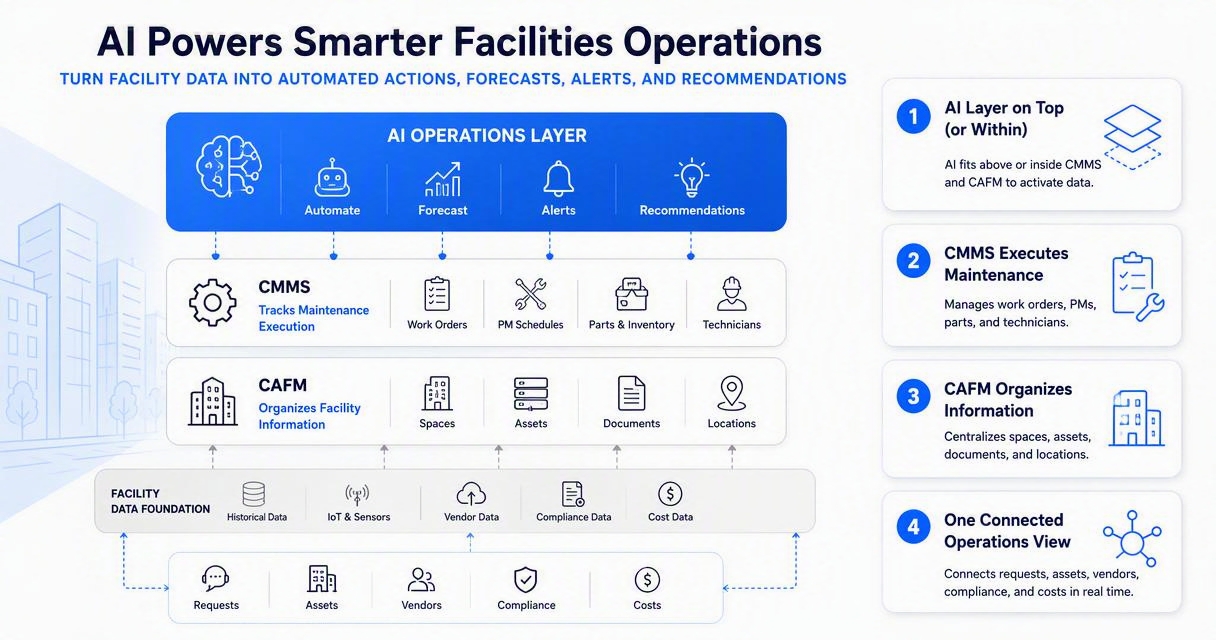
For multi-site operators, the biggest shift is visibility. A single-location CMMS may track a pump repair well. A multi-location AI workflow can compare similar failures across 200 stores, flag repeat vendors, and show which locations are drifting into higher reactive maintenance.
A deeper breakdown of multi-site operating models is covered in Leansite's guide to multi-location facilities management software.
AI, CMMS, CAFM, and IWMS comparison
| Category | Primary job | Best fit | Where AI adds value |
|---|---|---|---|
| CMMS | Maintain assets and work orders | Maintenance teams with equipment-heavy sites | Predictive maintenance, failure pattern detection, auto-filled work orders |
| CAFM | Manage space, occupancy, and facility data | Workplace and space planning teams | Space insights, request routing, planning summaries |
| IWMS | Connect real estate, facilities, and workplace operations | Large enterprises with complex portfolios | Cross-functional reporting and scenario analysis |
| AI facilities platform | Automate and improve daily operations | Multi-location teams, vendors, and executives | Triage, vendor dispatch, cost analysis, compliance prompts, dashboards |
No category is automatically better. A hospital campus, restaurant chain, self-storage portfolio, and corporate office group have different operating needs. The strongest choice is the one that connects the daily work queue with asset health, vendor accountability, and financial visibility.
Which workflows can AI automate in facility operations?
AI can automate the repeatable parts of facility operations, including ticket intake, work order drafting, priority scoring, preventive maintenance planning, vendor routing, compliance reminders, and dashboard summaries. It works best when the software has clean work history, clear asset records, location data, and consistent closeout notes.
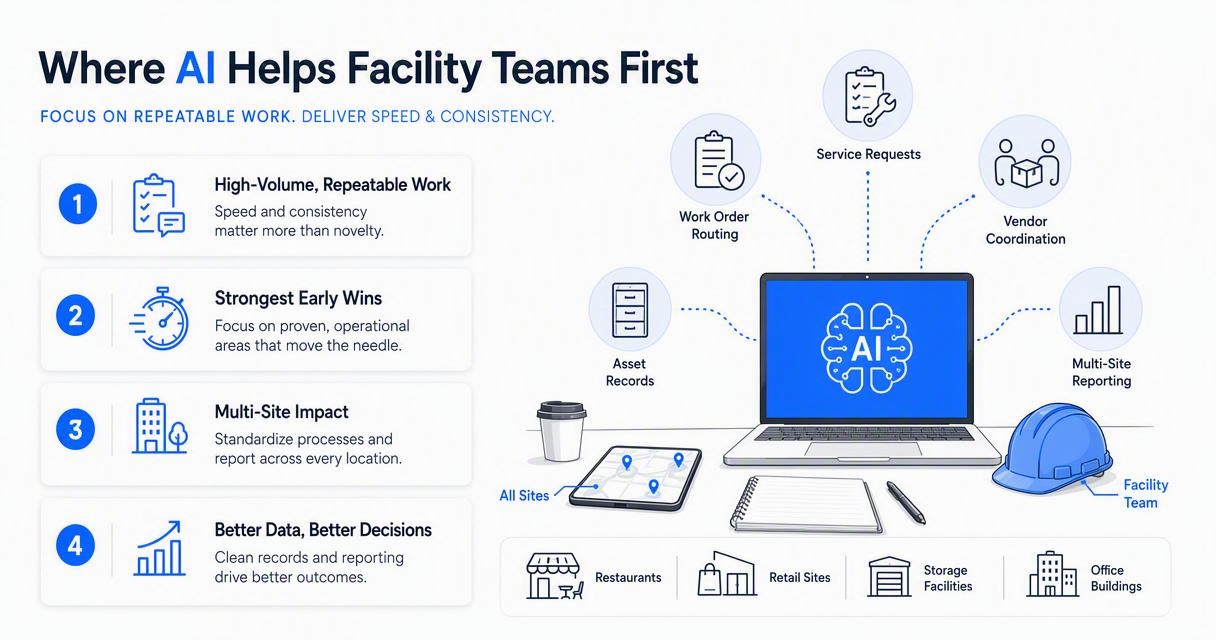
A useful framework is WOVCDC: work orders, operations maintenance, vendors, compliance, dashboards, and costs. Each area produces data every day. AI turns that data into faster decisions instead of another spreadsheet.
"AI is the new electricity.", Andrew Ng, Stanford Graduate School of Business
That quote fits facilities because AI becomes most valuable when embedded inside normal work, not treated as a separate experiment.
The WOVCDC automation framework
- Work orders: Convert requests into complete tickets with location, asset, priority, trade, photos, and suggested next steps.
- Operations maintenance: Detect repeat failures, suggest preventive tasks, and surface overdue inspections.
- Vendors: Match jobs to approved providers, track status, and summarize service notes.
- Compliance: Remind teams about inspections, documentation, safety checks, and audit trails.
- Dashboards: Turn open tickets, aging work, spend, and asset trends into plain-language summaries.
- Costs: Flag recurring repairs, compare locations, and support repair-versus-replace decisions.
The Leansite platform applies this kind of workflow thinking to facilities teams that need practical job tracking rather than another disconnected inbox. Teams evaluating ticketing depth can also compare requirements in the guide to the best facilities ticket management system for 2026.
What should buyers evaluate before choosing a platform?
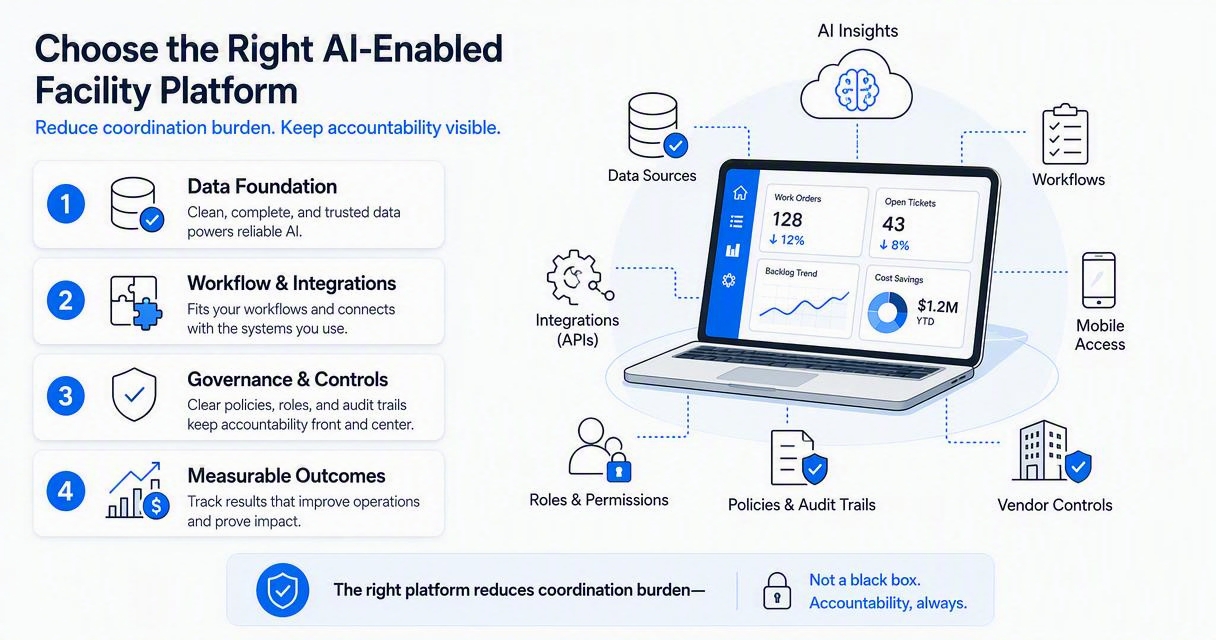
Buyers should evaluate AI facilities software by testing daily workflows, data quality requirements, mobile usability, vendor collaboration, reporting depth, permission controls, and rollout complexity. A strong demo should show how the system handles real tickets, not only polished sample data.
AI can produce weak recommendations when source data is incomplete, inconsistent, or trapped in disconnected tools. Research on generative AI in practice, including the 2023 paper by Dwivedi, Kshetri, Hughes, and coauthors in the International Journal of Information Management, emphasizes both the opportunities and governance challenges of generative AI systems (Elsevier PDF).
Strong connectivity also matters. Sensor-rich operations depend on reliable networks, and future building systems may benefit from advances in integrated sensing and communications discussed by Liu, Cui, Masouros, and coauthors in the IEEE literature on 6G and beyond (IEEE PDF). For facilities leaders dealing with patchy sites, the operational impact is covered in Leansite's article on poor connectivity in facilities management.
Buyer checklist for 2026 evaluations
- Work order quality: Can the system create complete, searchable, standardized tickets?
- Asset intelligence: Does asset history influence recommendations and maintenance plans?
- Vendor workflow: Can outside providers update jobs, attach proof, and close work cleanly?
- Portfolio reporting: Can leaders compare cost, backlog, aging, and downtime across sites?
- Controls and permissions: Can regions, vendors, executives, and site staff see only the right data?
- AI transparency: Does the system show why it suggested a priority, vendor, or next step?
- Mobile field use: Can technicians and managers update work quickly from the floor?
Restaurant chains have a special version of this buying process because uptime affects guest experience, brand standards, food safety, and equipment-heavy kitchens. That use case is covered in the guide to facilities management for restaurant chains.
How will AI facilities tools change in 2027?
AI facilities tools will become more agent-like in 2027, with software handling more routine coordination across tickets, vendors, inspections, sensors, and budgets. The near-term opportunity is not fully autonomous buildings; it is supervised automation that reduces manual chasing and improves decision speed.
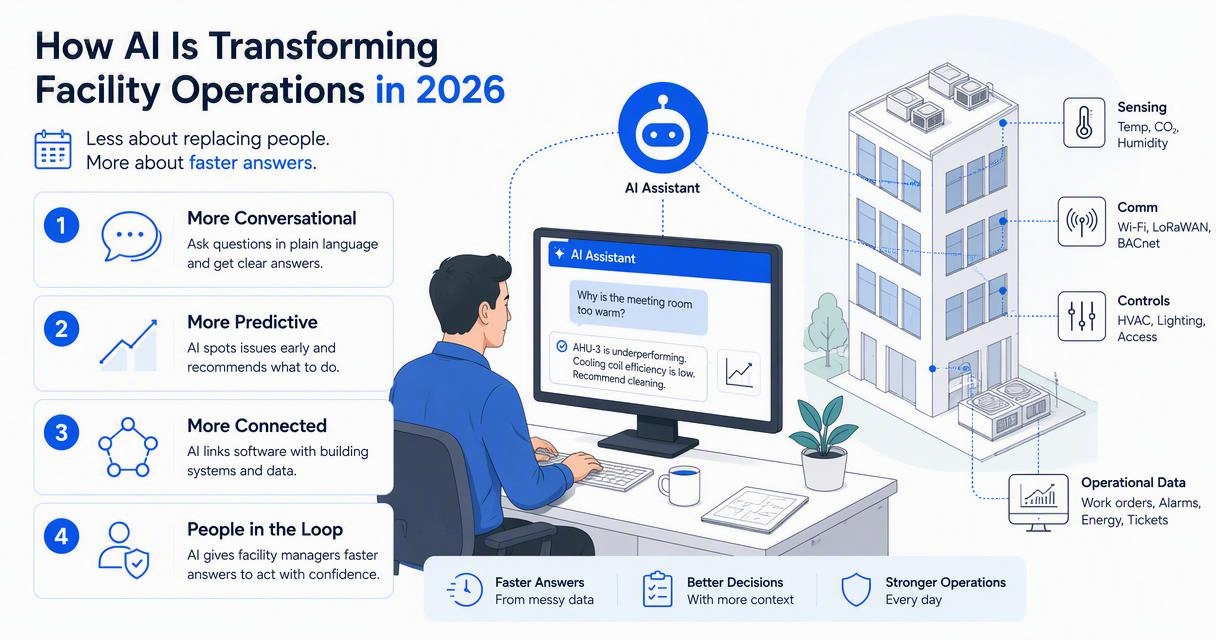
Expect three practical changes. First, AI assistants will move from answering questions to completing controlled actions, such as drafting scopes, requesting vendor updates, and preparing closeout summaries. Second, dashboards will become more conversational, letting executives ask about rising costs, repeat failures, or regional backlog in plain language. Third, asset histories will become more valuable as systems learn from each completed repair.
Leansite's Vera AI assistant is an example of this shift toward embedded help inside the facilities workflow. More background is available in the article on Vera, the AI assistant built into Leansite.
2027 watch: The winning platforms will not be the ones with the flashiest AI labels. They will be the ones that connect AI suggestions to real approvals, audit trails, vendors, and measurable operating outcomes.
FAQ about AI facilities software
AI facilities software raises practical questions about fit, data, staffing, and implementation. Clear answers help teams avoid overbuying and focus on workflows that create measurable value.
Is AI facility management software only for large enterprises?
No. Large portfolios benefit from cross-location pattern detection, but smaller teams can still gain value from faster work order intake, mobile updates, vendor tracking, and better reporting. The main requirement is repeatable facilities work with enough ticket history to reveal patterns and enough volume to justify automation.
Can AI predict every equipment failure?
No. AI can identify risk signals, repeated repair patterns, abnormal sensor data, and overdue maintenance, but it cannot guarantee perfect prediction. Facility leaders should treat predictive maintenance as a planning aid, not a promise. Human review remains important for safety, critical assets, warranty decisions, and capital planning.
How much data is needed before AI becomes useful?
AI becomes more useful when work orders include consistent fields such as asset, location, trade, priority, vendor, labor notes, parts, photos, and closeout reason. Even without years of history, software can still help standardize new requests and create cleaner records for future analysis.
Where should a facilities team start?
The best starting point is usually work order intake and vendor coordination because those workflows affect response time, documentation, and cost visibility every day. After that foundation is stable, teams can expand into preventive maintenance, compliance tracking, asset analytics, and executive dashboards.
Conclusion
AI facility management software is becoming the operating layer for modern facilities teams because it connects work orders, maintenance, vendors, compliance, dashboards, and cost control. The smartest next step is a workflow audit: list the top five recurring ticket types, the slowest approval steps, the most-used vendors, and the reports leadership asks for most often. Then compare platforms against those real operating needs. For teams ready to see how practical AI fits into daily facility work, visit getleansite.com and review how Leansite supports faster, cleaner operations across locations.