TL;DR
Maintenance compliance tracking software is most useful when it ties compliance records to assets, work orders, vendors, and deadlines in one place. Facilities teams should prioritize audit trails, inspection schedules, permit tracking, warranty records, vendor credentials, and multi-site reporting before choosing a system.
Missed inspections, expired permits, and undocumented repairs can turn routine maintenance into audit risk fast. Maintenance compliance tracking software gives facility managers a live record of what was done, who did it, when it happened, and which obligation it satisfied. For teams that need compliance tied to everyday work orders, Leansite helps connect task tracking, vendor coordination, and asset history without treating compliance as a separate spreadsheet.
Table of Contents
What is maintenance compliance tracking software?
Maintenance compliance tracking software: a digital system that tracks maintenance obligations, required records, deadlines, evidence, and approvals across assets, sites, vendors, and work orders.
Maintenance compliance tracking software helps facilities prove that inspections, safety tasks, permits, warranties, vendor credentials, and recurring service obligations are current. It usually overlaps with a computerized maintenance management system, or CMMS, which Wikipedia defines as software that stores information about an organization's maintenance operations.
"A computerized maintenance management system (CMMS) is any software package that maintains a computer database of information about an organization's maintenance operations.", Wikipedia contributors, Computerized maintenance management system
Compliance tracking matters because facility records are rarely just internal notes. They support OSHA safety expectations, insurance reviews, warranty claims, landlord obligations, tenant service commitments, and vendor accountability.
Core compliance records usually include:
-
Inspection logs: fire systems, elevators, HVAC, refrigeration, generators, roof access, life-safety equipment
-
Safety requirements: lockout/tagout records, PPE checks, hazard corrections, incident follow-ups
-
Warranty files: asset purchase dates, covered parts, approved service providers, repair history
-
Vendor credentials: certificates of insurance, licenses, trade certifications, background requirements
-
Permits: operating permits, occupancy-related documents, environmental approvals, equipment permits
-
Recurring service proof: preventive maintenance, calibration, cleaning, testing, filter changes, pest control
OSHA frames safety responsibility in plain terms:
"Under the OSH law, employers have a responsibility to provide a safe workplace.", Occupational Safety and Health Administration, Employer Responsibilities
Which compliance records should facilities track?
Facilities should track every maintenance record that proves an asset, site, vendor, or process met a required standard by a required date. The strongest systems link each record to a work order, asset, location, responsible party, due date, document, and approval status.
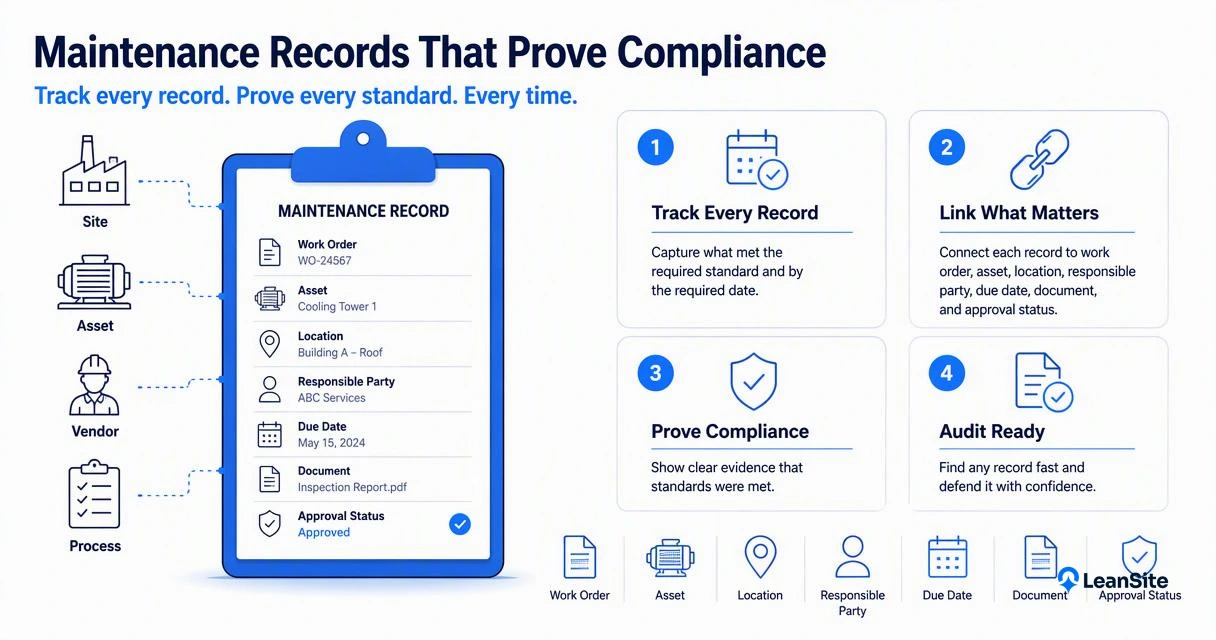
Compliance tracking checklist for audits and inspections
|
Record type |
What to track |
Why it matters |
|---|---|---|
|
Inspections |
Date, inspector, findings, photos, pass/fail status |
Shows required checks happened on schedule |
|
Safety tasks |
Hazard, corrective action, owner, closeout proof |
Supports workplace safety documentation |
|
Warranties |
Asset, coverage term, exclusions, repair history |
Protects covered repair claims |
|
Vendor credentials |
COI, license, expiration date, trade scope |
Reduces uninsured or unqualified work risk |
|
Permits |
Permit number, authority, renewal date, document |
Prevents operating with expired approvals |
|
Recurring service |
Frequency, checklist, technician, completion proof |
Confirms preventive work was completed |
|
Exceptions |
Missed task, reason, escalation, resolution |
Creates an audit trail for gaps |
A record is weak when it lives only in email, paper folders, or a vendor invoice. A record is strong when it is timestamped, attached to the right asset, searchable by site, and tied to the person or company that completed the work.
Multi-site operators face a harder version of the same problem. A national retail team, property portfolio, or distributed operations group needs one view of compliance status without calling every location. The guide to multi-location facilities management software covers that operating model in more depth.
How should maintenance compliance tracking work in 2026?
Maintenance compliance tracking should work as an active workflow, not a passive document folder. A modern system creates required tasks, alerts owners before deadlines, captures evidence in the field, escalates exceptions, and keeps an audit-ready history across every location.
A practical workflow for compliant maintenance
-
Map obligations to assets and sites. Fire panels, elevators, HVAC units, emergency lights, vehicles, kitchens, and other regulated assets need clear service rules.
-
Create recurring work orders. Each requirement should trigger the right inspection, test, or service task before the deadline.
-
Assign internal or vendor ownership. Responsibility should be visible before work starts, not debated after an audit notice.
-
Capture proof at completion. Photos, checklists, technician notes, forms, signatures, and invoices should attach to the work order.
-
Flag expired or missing records. The system should show overdue permits, missing COIs, failed inspections, and incomplete corrective actions.
-
Report by site, asset, vendor, and obligation. Executives need portfolio visibility, while managers need location-level detail.
Offline access also matters in basements, mechanical rooms, roofs, parking structures, and remote sites. Facilities that lose signal during inspections should review where offline maintenance software fits the compliance workflow.
The Leansite platform is built around that operational connection: work orders, assets, vendor activity, and location visibility in one system. That structure helps compliance records stay close to the work that created them.
Which features separate strong tools from basic trackers?
The best compliance tools reduce missed work, messy handoffs, and audit scrambling. Basic trackers store due dates; stronger systems automate recurring work, verify vendor readiness, preserve audit trails, and help leaders see risk across a portfolio.
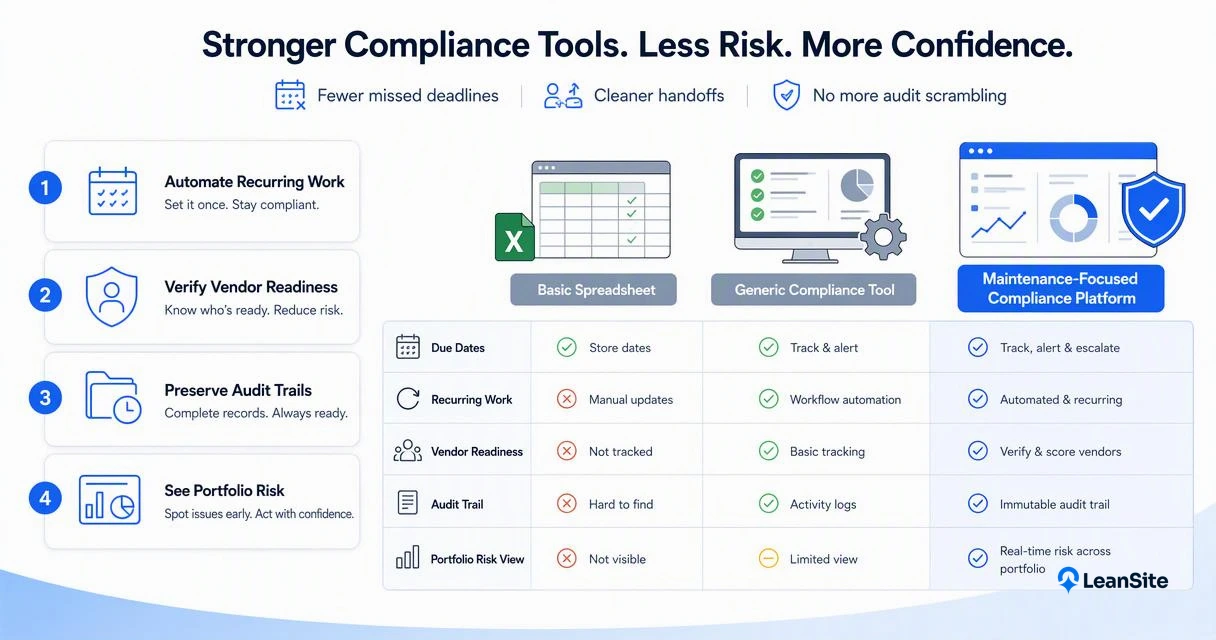
Feature comparison for facilities teams
Capability |
Basic spreadsheet |
Generic compliance tool |
Maintenance-focused platform |
|---|---|---|---|
|
Asset linkage |
Manual entry |
Limited |
Native asset history |
|
Work orders |
Not included |
Often separate |
Built into workflow |
|
Vendor COIs |
Manual reminders |
Document storage |
Expiration alerts and dispatch context |
|
Inspection proof |
File links |
Form capture |
Photos, checklists, timestamps, notes |
|
Multi-site reporting |
Hard to maintain |
Dashboard-based |
Site, asset, vendor, and task views |
|
Preventive maintenance |
Manual calendar |
Policy-based reminders |
Recurring work tied to assets |
|
Audit trail |
Version confusion |
Activity logs |
Full work order and approval history |
A facilities team should favor software that makes compliance part of daily maintenance. A tool that only stores policies can still leave managers chasing vendors, comparing invoices, and searching old email threads.
Vendor coordination is a major separator. Certificates of insurance, license expiration dates, dispatch notes, job status, and payment context all affect compliance readiness. Teams comparing automation options can review vendor dispatch and predictive maintenance automation for a deeper view of that workflow.
Preventive maintenance is another key test. A platform should create recurring tasks with checklists and due dates, then keep the proof. The article on building a preventive maintenance ticket flow explains how recurring work can become easier to verify.
What should buyers expect next?
In 2026 and beyond, compliance tracking will become more predictive, more automated, and more connected to field execution. AI will help summarize records and surface risks, but facilities teams will still need clean source data, clear workflows, and accountable approvals.
2026 buying criteria for maintenance leaders
A strong buying process should test the system against real facility scenarios, not demo data. The most useful questions focus on proof, timing, ownership, and reporting.
Key criteria include:
-
Time to evidence: How fast can a manager find the last inspection, photo proof, and technician notes for one asset?
-
Expiration visibility: Are permits, COIs, licenses, and warranties visible before they lapse?
-
Exception handling: Can failed inspections trigger corrective work and escalation?
-
Portfolio reporting: Can leaders compare sites without manually merging exports?
-
Field usability: Can technicians complete checklists from the job site with minimal friction?
-
AI readiness: Are records structured well enough for summaries, risk flags, and trend analysis?
Research on generative AI highlights both opportunity and caution for organizations using AI in practice and policy, including the need to manage quality and implications carefully, as discussed by Dwivedi, Kshetri, Hughes, and coauthors in the International Journal of Information Management opinion paper. For facilities, that means AI should assist with summaries and prioritization, not replace accountable records.
Teams comparing systems across many properties may also find the 2026 review of multi-site maintenance software useful. For operational visibility across locations, maintenance management without losing visibility is a related next read.
With Leansite, compliance tracking works best when task execution, site reporting, and vendor coordination are managed together. For a closer look, facility teams can visit getleansite.com and review how the platform supports maintenance operations.
Conclusion
Maintenance compliance tracking software should prove that required work happened, not merely remind a team that work was due. The right system connects inspections, safety tasks, warranties, permits, vendor credentials, and recurring service to real work orders and searchable evidence.
A practical next step is simple: list the top 20 recurring compliance obligations across the portfolio, match each one to an asset or site, then check whether current software can show status, owner, proof, and expiration date in under two minutes. If that test fails, a maintenance-first platform deserves a closer look.