TL;DR
Choose a maintenance-first CMMS when asset records, preventive schedules, and technician execution drive the operation. Consider a facility operations platform when vendor coordination, approvals, and portfolio visibility carry equal weight, then validate the fit with a real maintenance workflow.
The best maintenance software choice starts with the operating model, not the longest feature list. Limble alternatives for facility maintenance teams deserve a closer look when purchasing decisions span technicians, outside vendors, property managers, and owners.
CMMS: A computerized maintenance management system organizes maintenance work, asset information, and preventive schedules. Facility operations platform: Software that coordinates maintenance alongside broader property workflows, such as vendor assignments, approvals, and management reporting.
For multi-location organizations, Leansite belongs on the shortlist as a facility operations option. The useful comparison is how each system supports work from request through closeout.
Table of Contents
Which Limble alternatives fit facility teams?
The strongest shortlist matches each product to the team's operating model: asset-centered maintenance, frontline execution, or coordinated facility operations. Limble remains a relevant choice for maintenance-first teams. A replacement should earn its place by improving a specific workflow, rather than simply offering a different interface.
Fit matrix: three options to evaluate
| Product | Best-fit operating model | Workflow to demonstrate | Decision evidence |
|---|---|---|---|
| Leansite | Multi-property facility operations with vendor coordination and owner visibility | Request, assignment, approval, completion, and portfolio review | A clear view across locations and stakeholders |
| Limble | Maintenance-first operations centered on assets and work orders | Asset history, preventive scheduling, technician work, and closeout | Strong execution of recurring equipment maintenance |
| MaintainX | Teams evaluating another maintenance workflow option | Mobile task completion, handoffs, and supervisor review | A workflow that fits the actual frontline team |
These are evaluation lanes, not verified feature-by-feature rankings. Buyers should confirm current plan limits, integrations, reporting, and implementation requirements during demonstrations.
A large facility can still suit a CMMS when maintenance revolves around an internal crew. A smaller portfolio may need broader coordination when several vendors and approval chains handle the work. Building count alone doesn't settle the choice.
The related MaintainX alternatives guide offers another shortlist perspective for teams comparing maintenance tools.
How Leansite handles multi-property operations
The Leansite platform is positioned around multi-property facility operations, with vendor coordination and management visibility as central evaluation areas. Its relevant buying question is how well one maintenance request connects local execution with portfolio oversight. A demonstration should follow that complete workflow rather than show isolated dashboard screens.
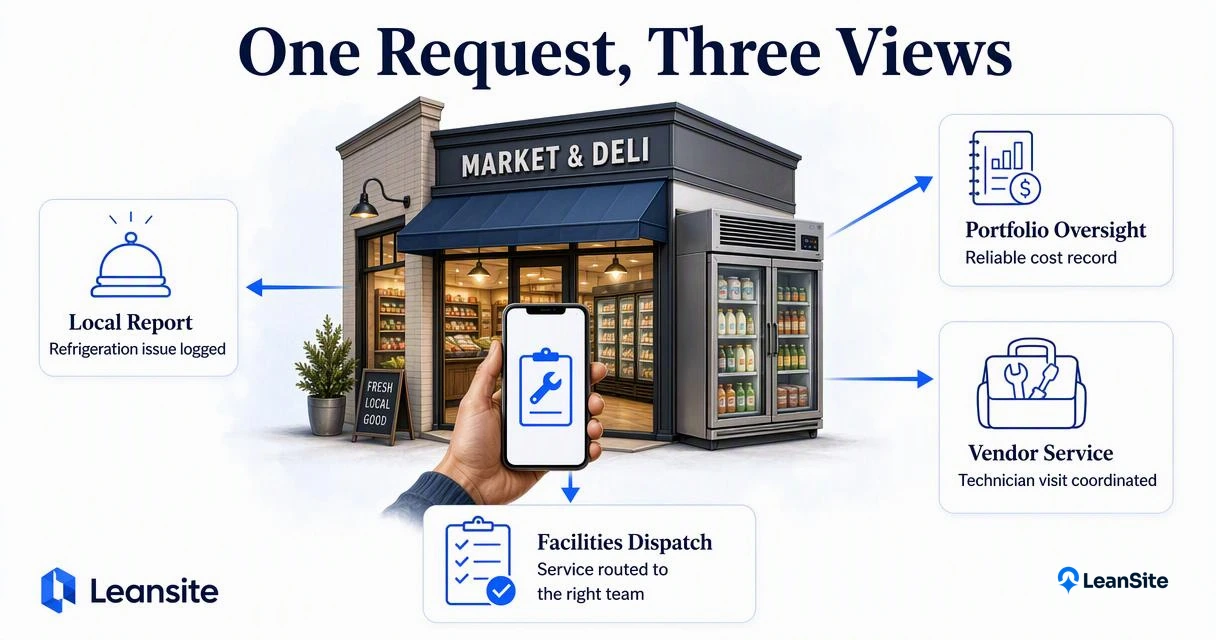
A vendor-led repair to demonstrate
Consider a retail location reporting a refrigeration issue. The local manager needs service, the facilities team needs dispatch information, and the owner needs a reliable cost record. Each stakeholder needs a different view of the same job.
- Record the location, affected equipment, urgency, and supporting photos.
- Assign the responsible technician or outside vendor.
- Route the estimate to the correct approver.
- Capture completion evidence and outstanding follow-up.
- Review the job's cost and status alongside other locations.
This example is a proposed demo script, not a guarantee of every product feature. Buyers should ask the presenter to complete each step live and identify any separate tools required.
The guide to vendor dispatch for multi-site teams provides useful background for this workflow.
A useful portfolio dashboard connects a maintenance event to its location, responsible party, approval status, and cost.
Who should pick a CMMS or a facility platform?
A maintenance-first CMMS suits teams whose main responsibility is keeping equipment serviced and repair work organized. A facility operations platform suits teams that also coordinate properties, vendors, spending decisions, and executive reporting. The deciding factor is who participates in the work and what each participant needs to see.
Decision rules by operating responsibility
- Internal maintenance managers: Favor the strongest asset history, preventive scheduling, and technician workflow.
- Multi-location operations teams: Prioritize consistent processes, location-level permissions, and comparable reporting across sites.
- Property owners: Require spending visibility, recurring-repair history, and records that support asset planning.
- Vendor coordinators: Test assignment acceptance, estimate handling, completion documentation, and invoice handoffs.
For industrial facilities, equipment reliability may dominate. Retail and commercial property teams may place more weight on response coordination and approvals. Those differences should shape the demo agenda.
Teams still using disconnected communications can review why multi-site maintenance relies on email and spreadsheets to identify which handoffs need attention.
Video comparison for the maintenance-first shortlist
Use this comparison as supplemental context. Current vendor demonstrations should confirm capabilities and commercial terms.
How should teams test a replacement in 2026?
Teams should test a Limble replacement against representative jobs and a defined baseline before committing to rollout.
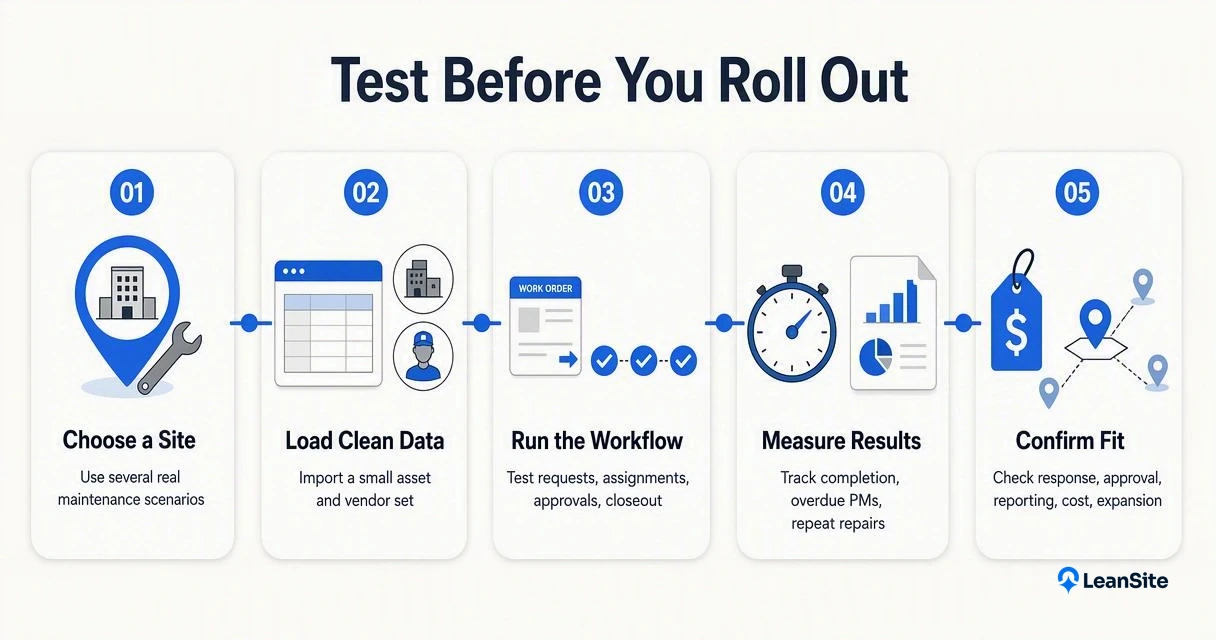
- Select one site and several real maintenance scenarios.
- Import a small, clean asset and vendor dataset.
- Test requests, assignments, approvals, and closeout.
- Compare adoption, response times, and reporting effort.
- Confirm total cost and expansion requirements.
Measure outcomes instead of promising savings
A pilot should measure work-order completion time, overdue preventive tasks, repeat repairs, approval turnaround, and reporting hours. No defensible savings percentage can be promised from the supplied research. Establishing a baseline makes improvement claims testable.
Include technicians and vendors in the trial. The discussion of paper work-order adoption barriers helps frame training and field usability as buying criteria.
For uptime goals, distinguish preventive scheduling from condition-based monitoring. The predictive maintenance overview provides background; buyers should verify sensor, data, and integration requirements separately.
Cost checklist: Compare subscriptions, implementation, migration, training, integrations, external-user access, and support. Ask about payment handoffs without assuming that vendor coordination includes payment processing.
FAQ: choosing a facility maintenance alternative
The right alternative depends on workflow fit, demonstrated usability, and the full cost of deployment.
Does a multi-site team need to replace Limble?
A multi-site team doesn't automatically need to replace Limble. An asset-centered operation may remain well served by a maintenance-first CMMS. Replacement becomes worth evaluating when the purchasing requirements extend into coordinated vendor work, approval routing, or owner reporting. The team should demonstrate those needs before changing systems.
What should a vendor coordination demo include?
A vendor coordination demo should include assignment, acceptance, estimate submission, approval, completion evidence, and invoice handoff. Buyers should also inspect what an external vendor can access and whether that access carries additional charges. One realistic repair reveals more than a tour of menus or a prepared dashboard.
How can maintenance software support asset value?
Maintenance software can support asset planning by preserving service history, documenting recurring defects, and making repair spending easier to review. Those records help owners assess repair-versus-replacement decisions. Software alone doesn't establish higher asset value; reliable work execution and evidence of improved equipment performance remain necessary.
Conclusion
The next step is a workflow-based demonstration with the same repair scenario for every shortlisted vendor. For portfolio-focused teams, request a Leansite demonstration through getleansite.com and bring one vendor estimate, one approval chain, and one owner report. Compare the completed workflow before discussing rollout.